Spine
Extremely flexible, compressing and releasing like a spring.
Each stride can reach about 7 meters, several times body length.
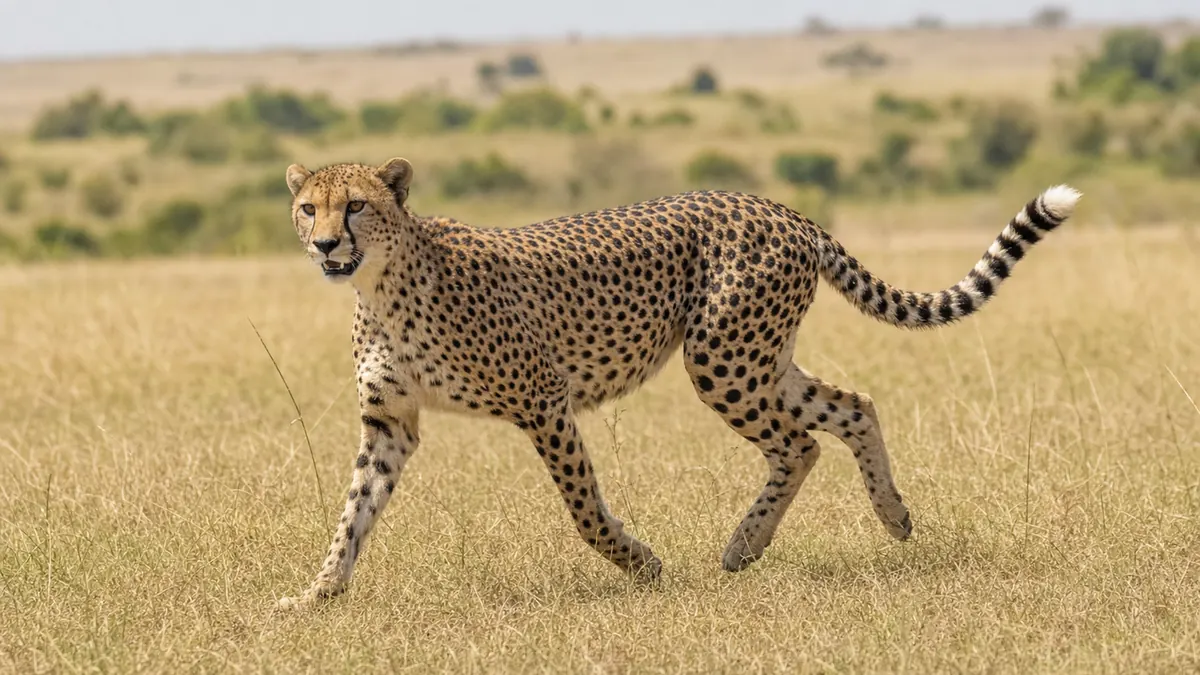
Species Profile
Acinonyx jubatus
The cheetah doesn't hunt like other cats. It doesn't ambush. It doesn't stalk in the dark. It runs in broad daylight, at up to 114 km/h, and it has about 30 seconds to make it count.
⚡ 114 km/h — top recorded speed
⏱️ ~3 sec — 0 to 100 km/h
🌍 ~6,517 — mature individuals in the wild
Source context: IUCN, Britannica, CCF, and San Diego Zoo.
Built for Speed
Every part of the cheetah's body is a speed adaptation. Not some parts. Every part.
Extremely flexible, compressing and releasing like a spring.
Each stride can reach about 7 meters, several times body length.
Semi-retractable claws stay exposed more than other cats.
They work like cleats for grip, with climbing ability as the tradeoff.
Large nostrils, lungs, and heart move oxygen fast.
The body is built for a brief oxygen-hungry sprint, not endurance.
Black lines run from eyes toward the mouth.
They may reduce glare during daylight hunts across open country.
Powerful hips and abdominal muscles drive acceleration.
A cheetah can reach highway speed before prey fully reacts.
Long, muscular, and flattened compared with many cats.
It works like a rudder when the animal turns at speed.
A cheetah does not stop because the drama is over. It stops because the body is becoming dangerous to itself. After a sprint, heat builds fast, breathing is violent, and the animal often has to lie still before it can feed. That pause is when lions, hyenas, or leopards can steal the kill. Speed is its only capital, and also its largest weakness.
Range
Cheetahs once ranged across much of Africa, the Middle East, and parts of Asia. Today their range is a fraction of that historic map. They are animals of open country: savanna, grassland, semi-arid scrub, and farm-edge rangeland where speed still matters.
Dense forest is a poor fit. A cheetah needs visibility, turning room, and chase distance. It needs space where prey can be seen before it vanishes, which is why links to grassland animals and savanna animals matter for the S-series habitat network.
Main range
Serengeti, Maasai Mara, Etosha, Kalahari
Largest single population stronghold
Farm edges and open rangeland where conflict is common
Last Asiatic cheetahs
Arid reserves and desert-edge mountain systems
Experimental reintroduction since 2022
Protected grassland and woodland mosaics
Diet & Hunt
The cheetah is the big cat that hunts by sight, in daylight, and by outrunning its prey. No heavy ambush. No night-dominant strategy. Just speed, precision, and a very short window.
Step 1
Sharp daytime vision finds a young, isolated, or lagging animal.
Step 2
The cheetah closes distance quietly until the chase is short enough.
Step 3
Acceleration peaks fast; most chases are brief and under a few hundred meters.
Step 4
A front paw and dewclaw knock prey off balance at speed.
Step 5
The throat bite kills by suffocation rather than brute force.
Step 6
The cheetah rests before feeding, when larger predators can steal the kill.
Main prey includes Thomson's gazelles, impalas, springboks, and other small to medium antelopes. Hares, birds, rodents, and young animals fill gaps when the perfect chase is not available.
Cheetahs are efficient hunters, but winning the chase is not the same as keeping the meal. A lightweight body can catch prey, then lose it to stronger carnivores before the first bite.
Social Life
Mother with 1-6 cubs
Nomadic, following prey and avoiding stronger predators.
Usually 2-3 males, often brothers
Defends territory and can hunt larger prey together.
One adult male
Hardest path; less power to hold territory.
Cheetah cubs are born with a long gray mantle down the back. It breaks up their outline in grass, and may mimic the rough look of a honey badger. For an animal whose babies are so vulnerable, even a hint of danger can be useful.
Cheetahs cannot roar. Mothers and cubs use birdlike chirps to find each other, and adults purr, bark, growl, and hiss. The sound fits the animal: less thunder, more signal.
Conservation
⚠️ IUCN Red List: Vulnerable
Population
~6,517 mature individuals
Trend
Decreasing
Historic loss
Down more than 90% from early 1900s estimates
Agriculture and settlement split open rangelands into smaller pieces. Cheetahs need large connected ranges, so fragmentation can isolate animals before numbers look catastrophic.
Many cheetahs live outside parks, especially around farms. Even when livestock losses are limited, fear and retaliation can remove breeding adults.
Cubs are trafficked for the exotic pet trade. Removing cubs also removes mothers' reproductive investment, and many cubs die before reaching buyers.
A prehistoric bottleneck left cheetahs unusually genetically similar. That makes disease, fertility, and long-term adaptability more serious conservation concerns.
High-intent comparison
Cheetah = tear marks + solid spots + built to run.
Leopard = no tear marks + rosette spots + built to climb.
Spot shape
Solid black dots
Hollow rosettes
Face
Black tear marks
No tear marks
Body
Slim, long-legged, narrow waist
Stockier and more muscular
Weight
21-65 kg
31-90 kg
Speed
Up to 114 km/h in a sprint
About 58 km/h
Climbing
Poor climber for a big cat
Strong climber; stores kills in trees
Active time
Mostly daylight
Mostly night or twilight
Voice
Chirps and purrs; cannot roar
Can roar
Hunting style
Pursuit predator
Ambush predator
Cheetah Facts
Their throat anatomy is different from roaring big cats, but they can purr.
The grip helps at speed, but the claws wear down and climbing suffers.
A bottleneck thousands of years ago still shapes disease risk today.
The gray mantle may make cubs look less like easy prey.
After a chase, the animal must cool down before it can safely feed.
Historic capture for coursing removed animals from already fragile wild populations.
Generator Links
Get a unique cheetah result with habitat, personality, and story context.
Generate Now →Cheetah x Peregrine Falcon? Cheetah x Great White Shark? The hybrid generator has no rules.
Try Hybrid Generator →FAQ
The maximum recorded speed of a cheetah is about 114 km/h (71 mph). During a typical hunt, cheetahs often reach 80-100 km/h and can accelerate from 0 to 100 km/h in roughly 3 seconds.
The global wild cheetah population is estimated at about 6,517 mature individuals in the 2021 IUCN assessment, down from far higher historic numbers across Africa and Asia.
Cheetahs are listed as Vulnerable on the IUCN Red List with a decreasing population trend. The Asiatic cheetah in Iran is in much worse condition, with only a tiny remnant population.
Cheetahs mainly eat small and medium antelopes such as Thomson's gazelles, impalas, and springboks. They may also take hares, birds, rodents, and young animals when available.
No. Cheetahs cannot roar. They communicate with chirps, purrs, growls, hisses, and barks, and they can purr while inhaling and exhaling.
In the wild, cheetahs commonly live around 10-12 years. Captive individuals can live longer, sometimes into the mid to late teens.
Cheetahs have solid spots, black tear marks, a slim body, and a pursuit hunting style. Leopards have rosette spots, no tear marks, a stronger climbing body, and usually hunt by ambush.
Cheetahs give birth after a gestation of about 93 days. Litters can range from 1-6 cubs, with 3-4 common, but cub mortality is high where lions, hyenas, and other threats are present.
Most wild cheetahs live in sub-Saharan Africa, especially in open savanna, grassland, and semi-arid rangeland. A very small Asiatic population survives in Iran, and India began a reintroduction program in 2022.
Cheetahs evolved a flexible spine, long legs, semi-retractable claws, large oxygen-delivery organs, and a muscular steering tail. Those adaptations make speed their core hunting strategy.