Scientific name
Panthera leo
Big cat in the genus Panthera
🦁 The only social big cat on Earth.
Population down 43% in two decades. ~23,000 left in the wild.
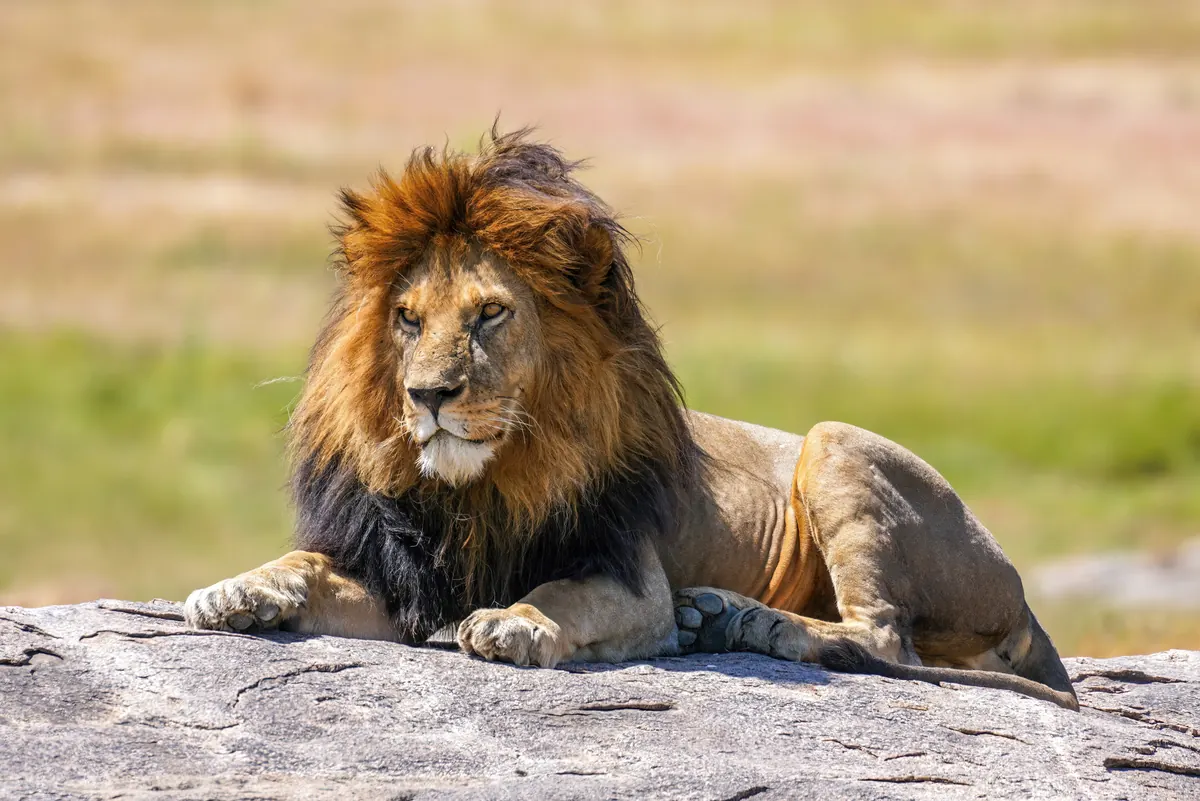
Species Profile
Panthera leo
Every big cat on Earth is a solitary hunter. The leopard. The tiger. The jaguar. The cheetah. Then there is the lion.
The lion made a different choice. It chose the pride. That single evolutionary decision changed its body, behavior, dominance, and fate.
⚖️ 272 kg — max recorded male weight
💨 80 km/h — top speed
🔊 8 km — roar can carry this far
🌍 ~23,000 — left in the wild
Source context: IUCN Cat Specialist Group, Britannica, San Diego Zoo, and AWF.
Fast Facts
Scientific name
Panthera leo
Big cat in the genus Panthera
Male weight
150-272 kg
Average about 190 kg
Female weight
120-182 kg
Lionesses are smaller and more agile
Body length
1.7-2.5 m
Head and body length for adult males
Shoulder height
About 1.2 m
Standing height at shoulder
Top speed
80 km/h
Short explosive sprint
Roar distance
8 km
Long-range territorial broadcast
Wild lifespan
10-16 years
Males often shorter, females longer
Captive lifespan
17-25 years
Captive individuals may live longer
Conservation
Vulnerable
IUCN Red List status
Wild population
~23,000
Recent conservation estimate
Habitat
Sub-Saharan Africa + Gir Forest
African lions plus Asiatic lion remnant
Pride Life
A tiger defends huge forest territory alone. A leopard hunts in silence. A cheetah raises cubs without a partner. The lion looked at the open savanna and evolved a different answer: build a coalition. For more context on that ecosystem, see savanna animals.
2-18
Related females form the hunting, cub-rearing, and territorial core.
1-4
Often brothers or coalition partners defending the pride from outside males.
Variable
Raised communally, with nursing and protection shared by females.
About 15
Large prides can exceed 30 individuals when prey and territory allow it.
| Trait | Lion pride | Solitary big cat |
|---|---|---|
| Hunting success | ~50% in coordinated groups | ~20-25% alone |
| Cub survival | Higher with group defense | Lower with single mother defense |
| Territory defense | Roars, patrols, coalitions | Scent marks and avoidance |
| Prey size | Can take buffalo and giraffe | Mostly medium or smaller prey |
| Individual risk | Shared across the group | Injury can end survival |
The Mane
No other cat has it. It costs energy, traps heat, and makes a male more visible. Evolution kept it because the signal is worth the cost.
The mane covers the neck and throat, the places rivals try to damage.
A thicker mane can reduce fatal injury during male contests.
Dark, dense mane growth is linked with maturity, condition, and hormones.
Females often prefer males whose mane signals costly fitness.
The mane makes the front profile look larger than the body alone.
Looking bigger can prevent a fight before teeth are used.
A heavy mane traps heat on hot savanna days.
It is an honest signal because unhealthy males cannot carry the cost as well.
Pale mane begins
Mane darkens and lengthens
Dark brown to black and thick
May thin or fade
The Hunt
Lions are not the fastest predators and not the stealthiest. Their edge is coordination: reconnaissance, encirclement, short sprint, takedown, and a feeding order that keeps pride politics visible.
~50%
group hunting success rate in favorable coordinated hunts
85%
many hunts happen at night, dusk, or dawn
Zebra
common prey in many lion landscapes
Buffalo
large regular prey that can require multiple lions
A lion can reach 80 km/h in a burst, but unlike a cheetah, it wins by positioning. For speed context, compare it with the fastest animals.
Subspecies
Modern taxonomy recognizes two major lion lineages. They are separated by an entire continent and thousands of years of isolation.
Panthera leo leo
Tsavo males in Kenya are famous for sparse or absent manes, a likely compromise between heat, thorn habitat, and sexual signaling.
Panthera leo persica
Asiatic lions recovered from roughly 20 individuals in the early 20th century, but a single forest population is still one catastrophe away from disaster.
Conservation
-43%
estimated African lion decline across recent decades
~23,000
wild lions remain, down from far higher historical numbers
75%
many lion populations continue to decline
In the 1970s, an estimated 200,000 lions roamed sub-Saharan Africa. Today, the number is roughly 23,000. Habitat loss, prey depletion, human-wildlife conflict, and fragmented populations have shrunk the kingdom. The Asiatic lion proves recovery is possible, but 700 animals in one landscape is not true safety.
Agriculture, roads, settlement, and fenced land split lion range into smaller isolated blocks. A pride needs space, prey, and contact with other populations.
When natural prey declines, lions take livestock. Retaliatory poisoning, shooting, and spearing remain major causes of human-linked mortality.
Bushmeat hunting and habitat pressure reduce the ungulates lions rely on, forcing more risky movement and more livestock conflict.
Legal trophy hunting is still debated in parts of the range, while illegal demand for lion bones adds pressure as tiger bone substitutes become scarce.
Triangle Link
The King of Beasts vs. the largest cat on Earth. The question is famous because both sides have real advantages. The tiger brings size and solitary kill precision; the lion brings combat experience, speed, and mane protection.
The honest answer depends on subspecies, terrain, individual condition, and motivation. For the full data table, historical records, liger genetics, and verdict, read the complete lion vs tiger breakdown.
⚔️ Read the Full Lion vs Tiger Breakdown →Generator Links
What kind of lion will you get? A Tsavo mane-less warrior? A Gir forest survivor? One click to find out.
Generate Now →The liger is the largest cat that has ever existed. See what happens when you combine these apex predators in the hybrid generator.
Generate Liger →The most debated question in the animal kingdom. Every piece of data, one honest answer.
See the Full Comparison →S-Series Species
Surprising Facts
The roar is a territorial broadcast and a social signal, not just a dramatic sound.
Rest is energy management for a large carnivore in hot open habitat.
A pride is not a simple dictatorship; lionesses are the stable social core.
Females often give birth around the same time, creating a shared nursery.
Tsavo lions show how heat, thorns, and local ecology can reshape the mane.
The gap between wild lions and captive lions is a conservation warning, not a success story.
FAQ
Male African lions typically weigh between 150-272 kg, with an average around 190 kg. Female lions are smaller, usually 120-182 kg. Asiatic lions are generally smaller than large African males, with males commonly around 160-190 kg.
In the wild, male lions often live 8-12 years because territorial fights are dangerous and physically costly. Female lions often live longer, around 15-16 years. In captivity, lions can live 17-25 years or more.
A lion's roar can be heard up to about 8 kilometers (5 miles) away. Roaring helps announce territory, coordinate pride members, and warn rival males, especially around dawn and dusk.
Recent estimates commonly place wild lions around 23,000 individuals, down sharply from roughly 200,000 in the 1970s. Most remaining lions live in fragmented sub-Saharan African populations, with about 700 Asiatic lions in India's Gir landscape.
The mane protects the neck during combat, makes a male look larger, and signals health, age, and hormone condition to females and rivals. Darker manes can indicate higher testosterone and strong condition, but they also carry heat costs.
Lions can sprint up to about 80 km/h (50 mph), but only for short distances. Their hunting strategy relies on coordinated positioning and ambush rather than long-distance pursuit.
Male lions do hunt, especially when alone or when targeting very large prey, but lionesses perform most regular hunting. Males contribute heavily through territorial defense and protection against rival males.
African lions are generally larger, have fuller manes, and live across fragmented parts of sub-Saharan Africa. Asiatic lions are smaller on average, often have sparser manes and a belly fold, and survive only in and around India's Gir Forest.
Lion vs tiger has no single scientific answer because the result depends on subspecies, size, terrain, and individual condition. Tigers usually have the size advantage, while lions have more male-male combat experience and mane protection. See the full lion vs tiger breakdown for the complete data. Read the full lion vs tiger analysis.