Scientific name
Canis lupus
Canid in the genus Canis
🐺 Everything you know about the alpha wolf is wrong.
A wolf pack is not a hierarchy. It is a family.
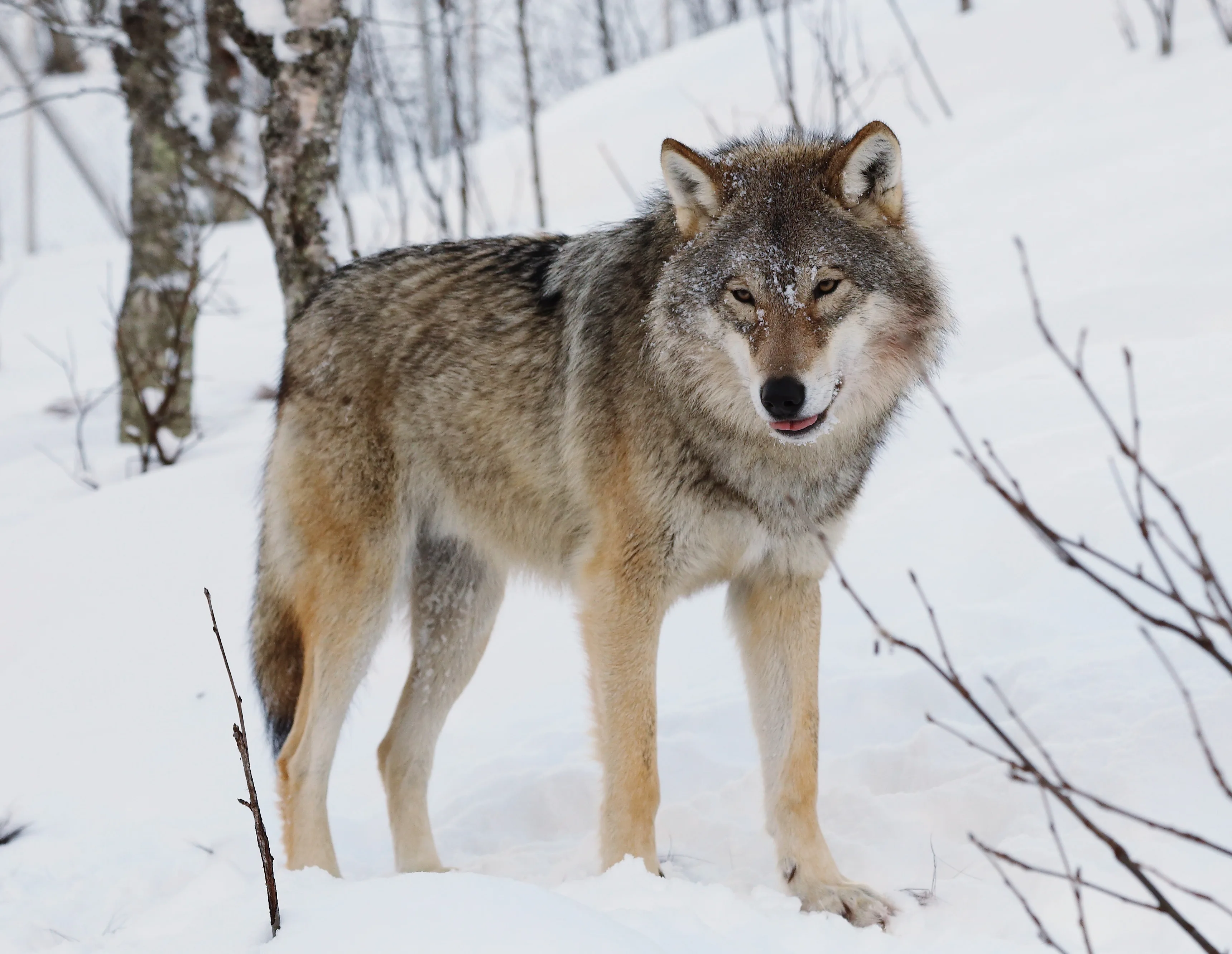
Species Profile
Canis lupus
You think you know the wolf. The alpha. The hierarchy. The dominance. The lone wolf. Almost all of it is wrong.
The scientist who popularized the alpha wolf idea spent years trying to correct it. Real wild wolf packs are families: a breeding pair and their offspring, led by experience rather than violence.
🏃 65 km/h - top sprint speed
📢 16 km - howl heard from this distance
🗺️ 1,000+ km2 - possible large territory
🌍 ~300,000 - gray wolves remaining worldwide
Source context: USGS, Animal Diversity Web, National Park Service, U.S. Fish & Wildlife Service, and Britannica.
Fast Facts
Scientific name
Canis lupus
Canid in the genus Canis
Male weight
30-80 kg
Varies strongly by region and subspecies
Body length
1.0-1.6 m
Head and body, excluding tail
Shoulder height
0.6-0.9 m
Yellowstone wolves are 26-36 inches tall
Top speed
65 km/h
Short sprint speed; endurance matters more
Howl distance
16 km
In open terrain, especially tundra
Territory
25-1,000+ km2
Driven by prey density and pack size
Pack size
2-30
Most wild packs are smaller family units
Wild lifespan
6-8 years
Yellowstone average is often lower
Gestation
About 63 days
Pups are usually born in spring
Litter size
4-6 pups
Yellowstone average is about five pups
Status
Least Concern
Global status hides threatened regional populations
Wild population
~300,000
A broad global gray wolf estimate
The Pack Myth
In 1970, biologist L. David Mech published The Wolf, and the alpha wolf entered popular culture. The problem was the original dominance model came from captive wolves: unrelated animals forced into an artificial group.
After years studying wild wolves, Mech and other field biologists found a different reality. Wild packs usually form as families, led by breeding parents. The science did not make wolves less interesting. It made them more interesting.
A wolf pack is not a tiny dictatorship. It is a survival system built from kinship, memory, sound, territory, and shared risk. That is closer to an elephant herd's respect for experience than a lion pride's coalition politics.
A typical wild wolf pack is a breeding pair plus their offspring from different years. The so-called alpha pair are usually the parents, not unrelated victors ruling by force.
Parents make the important calls because they know the territory: prey routes, danger zones, winter paths, den sites, and neighboring packs.
Most young wolves leave their birth pack between one and three years old. A lone wolf is usually looking for a mate and a territory, not wandering as a defeated outcast.
Tension can happen, especially around breeding and territory pressure. Most internal conflicts are resolved through posture, sound, and family relationships before injury.
| Concept | Alpha myth | Scientific reality |
|---|---|---|
| Leader | Strongest individual | Experienced breeding parents |
| Leadership style | Violence and intimidation | Decision-making and memory |
| Pack structure | Rigid military hierarchy | Family unit |
| Lone wolf | Failed outcast | Young disperser seeking territory |
| Submission | Fear of power | Family deference and social signaling |
The Howl
A wolf howl can cross open terrain for about 16 kilometers. It is one of the animal kingdom's great long-distance communication systems, and it is almost never about the moon.
Howling broadcasts pack presence across open country. Neighboring packs can answer from a distance, reducing the need for direct confrontation.
Before hunting or after members separate, howls help the pack reassemble. Individual wolves have recognizable voices.
A howl is not just a location ping. Its duration, pitch, and intensity can carry social and emotional information.
Adults use vocal signals around dens and rendezvous sites. Young pups begin vocalizing early and refine calls as they mature.
Group howling can make a pack sound larger than it is, a useful acoustic strategy in territorial landscapes.
Wolves do not howl at the moon as a target. Bright nights can increase movement and social communication, which makes the myth feel true.
The Hunt
The cheetah hunts with speed. The tiger hunts with stealth. The wolf hunts with stamina, coordination, and time. Most chases fail, but the pressure changes the prey equation.
65 km/h
sprint speed in short bursts
8 km/h
steady travel pace over long distances
14-20%
typical large-prey hunting success range
20+ km
distance a pack can cover in a hunt
Elk / moose
core prey in many northern systems
Select: Target vulnerable prey: old, injured, young, sick, or isolated animals.
Pressure: Keep moving and test the herd without spending full energy at once.
Coordinate: Use family familiarity to split roles without visible commands.
Commit: Sprint only when the prey is tired, cornered, or makes a mistake.
Feed: A large kill can support the pack, pups, ravens, bears, and other scavengers.
Subspecies
The gray wolf is one of Earth's most widespread mammals, from Arctic islands to dry scrublands. For broader habitat context, compare wolves with other forest animals.
Canis lupus arctos
Arctic wolves live with long polar nights, severe cold, and sparse prey. Remoteness has protected them from the large extermination campaigns that hit many southern wolves.
Canis lupus nubilus
This is the North American wolf many people imagine: a forest-and-plains hunter whose modern range is still a fraction of its historical footprint.
Canis lupus baileyi
The Mexican wolf is the smallest North American gray wolf and one of the clearest examples of recovery built from a genetic bottleneck.
Canis lupus lupus
As wolves return to parts of Europe, biology and politics collide: the animal can recover faster than human institutions adapt.
Canis lupus pallipes
The Indian wolf shows how far the gray wolf body plan can stretch: smaller, leaner, warmer-climate adapted, and built for open dry country.
Canis lupus familiaris
Every dog breed, from Chihuahua to Great Dane, is part of the gray wolf story: cooperation with humans became a new evolutionary path.
Yellowstone
In January 1995, 14 wolves were reintroduced to Yellowstone after roughly 70 years without a resident wolf population. Their return became the world's most famous trophic cascade story. The powerful version says wolves changed rivers. The scientific version is better: wolves helped restore a missing force in a system where elk, plants, beavers, climate, groundwater, hunting, and other predators all interact.
1995: 14 wolves arrive in Yellowstone after roughly 70 years without a resident wolf population.
Predation returns: Elk numbers and behavior begin changing alongside hunting, weather, other predators, and management outside the park.
Browsing pressure shifts: Willow and aspen recovery appears in some riparian zones, though causality is still debated by scientists.
Beavers gain material: More woody vegetation can support beaver colonies, wetlands, and slower water.
Rivers respond: Healthier riparian vegetation and beaver dams can stabilize banks and reshape local water habitat.
The real lesson: Wolves matter deeply, but the honest Yellowstone story is a complex food web, not a one-cause miracle.
14 wolves did not act like magic. They acted like apex predators: changing risk, movement, carcass availability, and ecological pressure. That is enough to make a landscape behave differently.
🐺 Generate a Wolf Pack →Triangle Link
Wolves and foxes share the same family, but they made opposite bets. The wolf bet everything on the pack. The fox bet everything on flexibility.
| Trait | Wolf | Fox |
|---|---|---|
| Weight | 30-80 kg | 3-14 kg |
| Strategy | Family cooperation and endurance pursuit | Solo opportunism and flexible intelligence |
| Territory | 25-1,000+ km2 | 2-50 km2 |
| Diet | Large ungulates plus smaller prey | Omnivorous, highly flexible |
| Social structure | Family pack, often 5-8 | Solitary or small family unit |
| Adaptability | Needs large intact habitat | Can thrive in cities |
| Status | Least Concern globally, threatened regionally | Least Concern |
Their contrast is one of nature's cleanest strategy splits: scale and flexibility, strength and wit, specialization and adaptation.
🦊 Read the Full Wolf vs Fox Breakdown →Generator Links
Arctic white? Timber wolf? Mexican wolf? One click to find out.
Generate Now →What if a wolf had a bear's strength, a fox's cunning, or a tiger's camouflage?
Try Hybrid Generator →Same family. Opposite strategies. Pack power vs solo intelligence.
See the Full Comparison →S-Series Species
FAQ
The alpha wolf concept, as popularly understood, is scientifically outdated. L. David Mech's later work on wild wolves showed that packs are usually family units: a breeding pair and their offspring. In that context, alpha mostly means parent. Leadership comes from experience, not constant aggression.
A wolf howl can be heard up to about 16 kilometers, or 10 miles, in open terrain. Wolves use howling for territory declaration, group assembly, individual recognition, and social contact. They do not howl specifically at the moon.
Wolves can sprint up to about 65 km/h for short distances, but their real hunting advantage is endurance. A pack can travel for hours, test prey repeatedly, and cover more than 20 kilometers during a long hunt.
A lone wolf is usually a young wolf, often one to three years old, that has dispersed from its birth pack to find a mate and establish a new territory. It is not usually a failed outcast.
Wolf territory size varies enormously with prey density, pack size, and landscape. Some territories are under 100 km2, while sparse northern or mountain landscapes can push territories beyond 1,000 km2.
Wolves were reintroduced to Yellowstone beginning in 1995, including 14 wolves that January. Their return helped restore predation and contributed to changes in elk, scavengers, and some riparian vegetation. The famous trophic cascade story is real but complex: NPS notes that climate, groundwater, other predators, hunting, and management also matter.
Yes. Domestic dogs descend from ancient gray wolf lineages and are classified as Canis lupus familiaris. Domestication likely began tens of thousands of years ago through a long association between some wolves and humans.
Wolves primarily hunt large ungulates such as elk, moose, deer, bison, and caribou, depending on region. They also eat smaller mammals, birds, fish, carrion, and berries when available.