Myth
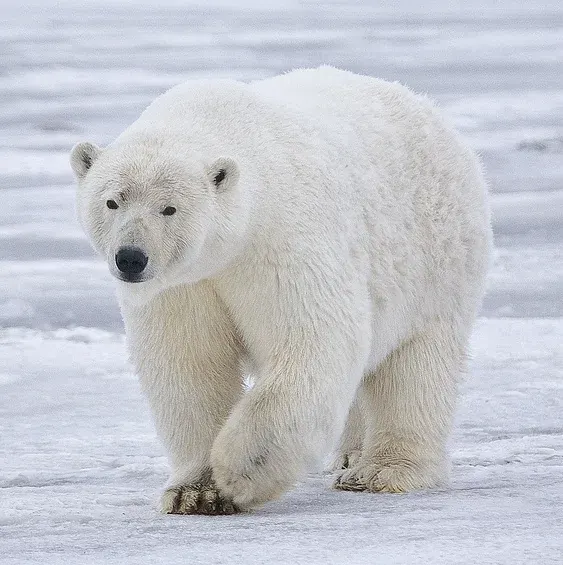
Polar bear fur is white
Actually
Polar bear fur is transparent
Each hair is a hollow, translucent tube. The coat appears white because it scatters visible light, the way snow does. Beneath it is black skin that helps absorb solar warmth.
🐻❄️ The polar bear's fur is not white. It is translucent. Its skin is black.
Perfect for a world that is disappearing.
Species Profile
The Perfect Predator of a Disappearing World
The polar bear is not endangered because it is weak. It is at risk because it is perfect for sea ice, and sea ice is retreating.
Transparent fur, black skin, seal hunting, long fasts, 19 subpopulations, and the climate clock reshaping the Arctic.
~26,000
Remaining
700+ kg
Large males
40+ km/h
Top speed
1 km+
Smell range
-50°C
Survival
2040
Risk window
Before the facts
Polar bears are familiar enough to feel simple. They are not. Three of the most repeated ideas about them are wrong or incomplete.
Myth
Actually
Polar bear fur is transparent
Each hair is a hollow, translucent tube. The coat appears white because it scatters visible light, the way snow does. Beneath it is black skin that helps absorb solar warmth.
Myth
Actually
Only pregnant females den
Males and non-pregnant females remain active through winter. Pregnant females enter maternity dens, give birth, nurse cubs, and can go months without eating.
Myth
Actually
Polar bears are marine mammals
Their Latin name means sea bear. They depend on sea ice as a hunting platform and spend much of life near, on, or in Arctic water.
Perfect adaptations
The polar bear body is an Arctic engineering system: insulation, camouflage, smell, paws, fat, and swimming power. The tragedy is that every adaptation assumes sea ice will be there.
Hollow translucent hairs trap air, shed water, and scatter light into snow-colored camouflage.
Dark skin beneath the coat absorbs solar radiation when light reaches the body.
Fat provides insulation, buoyancy, and the energy bank needed during fasting seasons.
Large paws spread weight on snow and ice; rough pads and claws improve grip.
Polar bears can locate seals and breathing holes across long distances and under snow or ice.
During food scarcity, bears reduce activity and rely on stored fat while remaining mobile.
Small ears, compact tail, and limb circulation help protect core heat.
Huge front paws work as paddles; polar bears can swim long distances between ice and shore.
The hunt
Polar bears are hypercarnivores. Seal fat is not a luxury; it is the energy architecture of their life cycle.
| Food | Role | Why it matters |
|---|---|---|
| Ringed seal | Primary prey | High-fat food source hunted from sea ice breathing holes |
| Bearded seal | Secondary prey | Larger seal taken when available |
| Harp seal | Opportunistic | Regional and seasonal prey |
| Walrus | Rare | Dangerous prey; mostly young or vulnerable individuals |
| Beluga whale | Opportunistic | Usually when trapped or accessible in ice |
| Carcasses / eggs / plants | Fallback foods | Can help on land, but rarely replace seal fat energetically |
The main hunting method is still hunting: wait at a seal breathing hole in sea ice, sometimes for hours, then strike when the seal surfaces. Remove sea ice and the hunting platform disappears.
Population
The short answer is about 26,000. The honest answer is more complicated: those bears are split across 19 subpopulations, and trend data is uneven.
| Metric | Current figure | Context |
|---|---|---|
| Global estimate | ~26,000 | Commonly cited current global estimate |
| Subpopulations | 19 | Recognized across Canada, Alaska, Greenland, Norway, and Russia |
| IUCN status | Vulnerable | Population trend listed as decreasing |
| Canada share | About two-thirds | Canada holds the largest share of the global population |
| Data uncertainty | Significant | Some subpopulations have limited trend data |
A global number can sound reassuring. But polar bears do not live as one global herd; they live as regional populations tied to local ice timing.
The clock
Climate change is not an abstract threat here. It removes the platform polar bears use to hunt, travel, mate, and raise young.
| Signal | Figure | Meaning for polar bears |
|---|---|---|
| Arctic warming | About 3-4x global average | The Arctic is warming far faster than the planet as a whole. |
| September sea ice trend | ~12-13% decline per decade | Satellite-era decline since 1979 for the annual minimum. |
| Ice-free summer risk | Possible by the 2030s-2040s | Timing depends strongly on emissions and model definitions. |
| Hudson Bay pressure | Longer ice-free season | Bears spend more time on land fasting instead of hunting seals. |
| Core mechanism | Less ice = less hunting | Sea ice is a feeding platform, not just scenery. |
The central equation
Less ice means less hunting.
A polar bear can be huge, fast, insulated, and intelligent. None of that replaces the ice platform where seals surface to breathe.
Polar bears hunt seals from sea ice. When ice forms later and melts earlier, the hunting season shrinks.
More time on land means more time burning fat reserves without replacing them with seal fat.
Females in poorer condition have fewer cubs and lower cub survival, especially in southern populations.
Fragmented ice can force bears to swim farther, spending energy they cannot easily recover.
Warming changes species overlap, bringing polar bears into more contact with humans, grizzlies, and new ecological pressures.
Comparison
Polar bears and grizzlies are close enough to hybridize, but they are built for different worlds: sea ice versus land, seal fat versus omnivory.
| Feature | Polar Bear | Grizzly Bear |
|---|---|---|
| Max weight | 700+ kg large males | 300-360 kg typical large males |
| Standing height | Up to about 3 m | Up to about 2.5 m |
| Top speed | 40+ km/h | 50+ km/h |
| Swimming | Long-distance specialist | Capable, not marine-specialized |
| Diet | Hypercarnivore; seal fat | Omnivore; plants, fish, meat |
| Habitat | Sea ice and Arctic coasts | Forests, mountains, tundra |
| Fur and skin | Transparent fur, black skin | Brown/blonde fur, lighter skin |
| Claws | Shorter, curved, ice grip | Longer, digging and foraging |
| Conservation | Vulnerable | Least Concern as brown bear globally |
| Verdict | Wins size and marine power | Wins speed and land agility |
Pizzly and grolar bears are not a novelty. They are a sign that warming is pushing Arctic boundaries into new contact zones.
Cubs
A polar bear mother enters the den with stored fat and emerges months later with cubs. The entire system depends on how much energy she gained on sea ice before denning.
| Stage | Timing / figure | Context |
|---|---|---|
| Mating | April-May | Usually on sea ice |
| Gestation | 195-265 days | Includes delayed implantation |
| Den entry | Autumn | Pregnant females dig maternity dens |
| Birth | November-January | Inside snow dens |
| Litter size | Usually 2 | Range is commonly 1-3 |
| Birth weight | ~600 g | Tiny compared with the mother |
| Den emergence | March-April | Cubs leave after rapid milk-fueled growth |
| Independence | 2-2.5 years | Long maternal care |
Fast facts
| Fact | Answer | Context |
|---|---|---|
| Scientific name | Ursus maritimus | Latin for sea bear |
| Population | ~26,000 | Spread across 19 subpopulations |
| Status | Vulnerable | IUCN Red List |
| Skin color | Black | Hidden beneath the fur |
| Fur color | Transparent / translucent | Appears white by light scattering |
| Primary prey | Ringed seals | Hunted from sea ice |
| Diet type | Hypercarnivore | Seal fat is the energetic core |
| Largest bear? | Yes, with Kodiak/brown bears close | Adult males are among the largest terrestrial carnivores |
| Swimming | Long-distance capable | Front paws drive propulsion |
| Main threat | Sea ice loss | Climate change reduces hunting opportunity |
Explore
The polar bear is the Arctic half of the site's polar arc. The other half is the penguin: another perfect adaptation, but with a different emotional shape.
penguin facts
Polar counterpart
whale facts
Marine mammal line
wolf adaptation
Adaptation contrast
ocean animals
Habitat hub
most dangerous animals
Risk context
FAQ
The global polar bear population is commonly estimated at about 26,000 individuals across 19 subpopulations in Canada, Alaska, Greenland, Norway, and Russia. The estimate is uncertain because some subpopulations are difficult to survey.
Polar bears are listed as Vulnerable by the IUCN Red List, not Endangered globally. Their population trend is decreasing, and the main long-term threat is sea ice loss caused by climate change.
Yes. Polar bear hairs are hollow and translucent rather than truly white. The coat looks white because it scatters visible light. Under the fur, polar bear skin is black.
Polar bears are hypercarnivores that rely mainly on ringed seals and their fat. They also eat bearded seals and opportunistic foods, but seal fat is the key energy source that supports survival and reproduction.
Adult male polar bears commonly weigh several hundred kilograms, and very large males can exceed 700 kg. Females are much smaller, often around 150 to 250 kg depending on season and condition.
Yes. Polar bears and grizzly bears can interbreed and produce fertile hybrids, often called pizzly or grolar bears. Wild hybrid records are rare but important because warming Arctic habitats can increase overlap.
Sources and data note
Polar bear population and sea ice projections vary by survey quality, region, emissions scenario, and model definition. This page uses cautious current wording and links to source material.