WOLF
Wolves are the reason your dog exists.
Domestic dogs descend from ancient wolf lineages, making wolf domestication one of humanity's most consequential animal relationships.
Wolf: 40-80 kg, hunts in packs, rules the forest.
Fox: 3-14 kg, hunts alone, lives where wolves cannot.
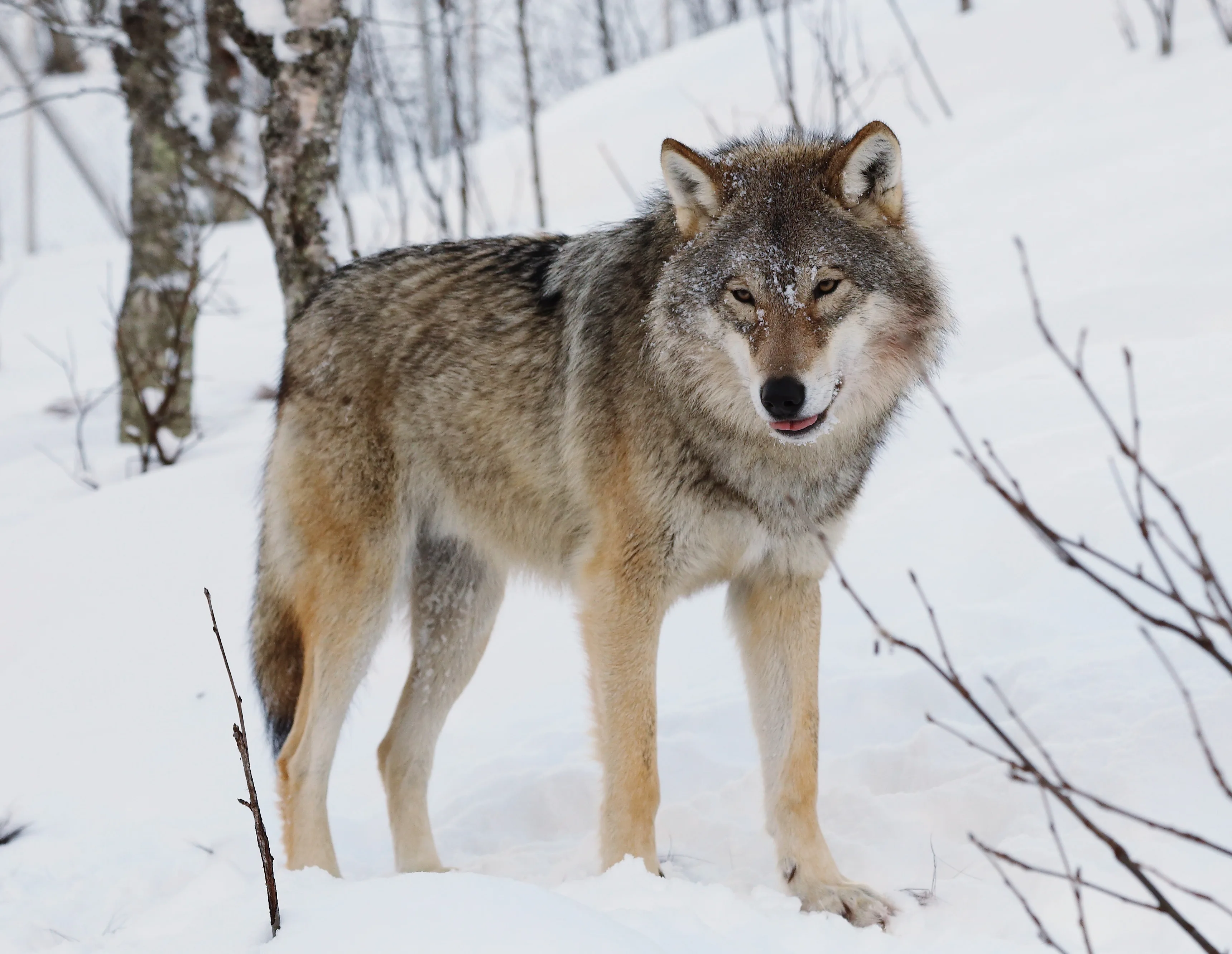
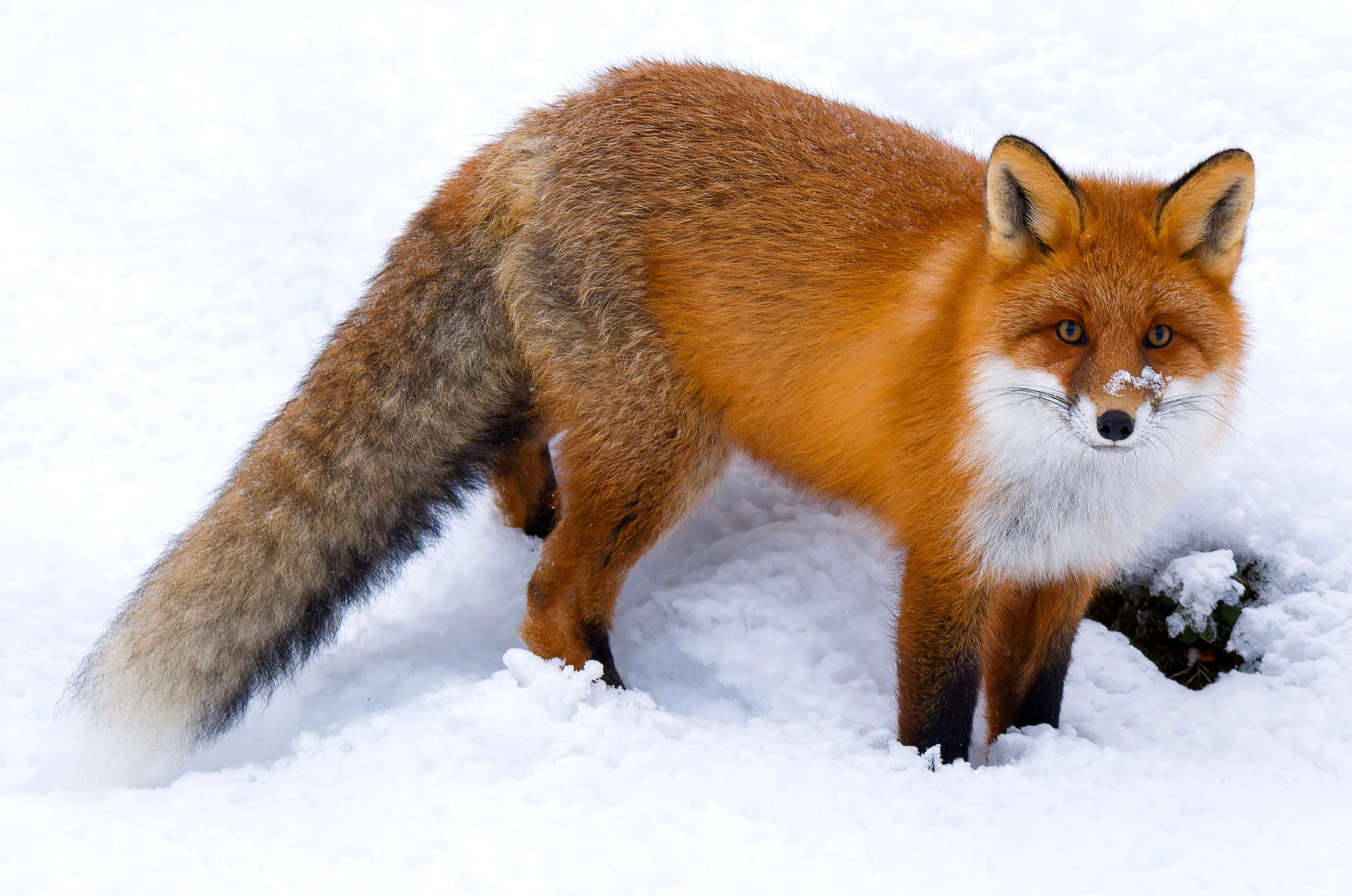
Comparison Series
Same family. 10x size difference. Completely opposite survival strategies.
The wolf built its success on strength, numbers, and territory. The fox built its success on intelligence, flexibility, and going exactly where the wolf cannot follow.
Wolf
Fox
Featured snippet target
Wolves and foxes are both canids, but they are not the same kind of animal. The wolf is a pack-based apex predator; the red fox is a solitary, adaptable generalist.
| Trait | Wolf | Red Fox |
|---|---|---|
| Scientific name | Canis lupus | Vulpes vulpes |
| Family | Canidae | Canidae |
| Genus | Canis | Vulpes |
| Weight | 40-80 kg | 3-14 kg |
| Body length | 1.0-1.6 m, excluding tail | 45-90 cm, excluding tail |
| Shoulder height | 60-90 cm | 35-50 cm |
| Running speed | 50-60 km/h | 48-50 km/h |
| Wild lifespan | 6-13 years | 2-5 years |
| Social structure | Family packs, often 6-10 | Solitary or small family units |
| Territory | 80-3,000 km2 | 5-50 km2 |
| Primary prey | Large ungulates | Rodents, rabbits, birds, insects |
| Habitat | Forests, tundra, grasslands, mountains | Almost every terrestrial habitat |
| Urban adaptation | Very low | Very high |
| IUCN status | Least Concern | Least Concern |
| Global population | About 200,000-250,000 wild wolves | Hundreds of millions |
| Relationship to dogs | Direct ancestor of domestic dogs | Not a dog ancestor |
Wolves and foxes are both canids but belong to different genera (Canis vs Vulpes). Wolves are 5-10x heavier, hunt in packs, and require vast territories. Foxes are solitary, highly adaptable, and thrive in cities where wolves cannot survive.
Scale
A wolf is built to challenge animals larger than itself. A fox is built to stay unseen, slip through gaps, and use less food.
Human
175 cm
Wolf
60-90 cm shoulder
Fox
35-50 cm shoulder
| Measurement | Wolf | Red Fox |
|---|---|---|
| Weight | 40-80 kg | 3-14 kg |
| Body length | 1.0-1.6 m, excluding tail | 45-90 cm, excluding tail |
| Tail length | 30-50 cm | 30-55 cm |
| Shoulder height | 60-90 cm | 35-50 cm |
Wolf
A moose can weigh more than 700 kg. To hunt prey at that scale, a wolf needs mass, leverage, stamina, and partners.
Fox
A fox is small enough for burrows, light enough for soft snow, and flexible enough for hedgerows, alleys, railway edges, and city gardens.
Speed & senses
The surprising part is not that wolves are fast. It is that foxes nearly match them while carrying a fraction of the body weight.
For more speed context, compare them with the fastest animals.
| Sense | Wolf | Red Fox |
|---|---|---|
| Smell | Can follow old scent trails and read territory marks. | Pinpoints prey under grass, leaves, or snow. |
| Hearing | Long-range howls can carry across open terrain. | Can hear small rodents moving under snow. |
| Vision | Strong motion detection and night vision. | Vertical pupils support low-light ambush hunting. |
| Special edge | Pack communication across distance. | Magnetic-field-assisted pouncing. |
The fox's strangest advantage is magnetic pouncing. Research in Biology Letters found red fox hunting success clustered along a northeast axis, suggesting foxes may use Earth's magnetic field as a rangefinder when leaping at hidden prey.
Two kinds of smart
Asking which animal is smarter is the wrong question. Wolves evolved intelligence for coordination. Foxes evolved intelligence for improvisation.
Wolf
Wolf intelligence appears in role switching, pack movement, territory communication, social repair, and group hunting decisions.
The limitation is context: an isolated wolf loses much of the advantage that makes wolves formidable.
Fox
Fox intelligence appears in caching food, remembering many hiding places, exploiting human landscapes, and changing diet quickly.
The limitation is cooperation: when the problem needs a team, foxes usually route around it instead of organizing one.
Different tables
Wolf
Fox
Wolves are experts. Foxes are generalists. In rich prey years, specialization is powerful. In unstable years, generalists often last longer.
Range
Wolves need intact ecosystems. Foxes need openings. That is why the wolf map is patchy while the fox map feels almost continuous.
| Habitat factor | Wolf | Red Fox |
|---|---|---|
| Native range | North America and Eurasia | Northern Hemisphere; introduced to Australia |
| Habitats | Forests, tundra, grasslands, mountains | Almost all terrestrial habitats |
| Urban adaptation | Very low | Very high |
| Elevation | Sea level to mountains | Sea level to high mountains |
| Minimum usable space | Large landscapes with prey | Small territories, even urban fragments |
Related habitat reading: forest animals.
Ecology
They are relatives, but distant ones. In the wild, the more important relationship is ecological: predator pressure, competition, avoidance, and niche partitioning.
Both are canids, but wolves sit in Canis and red foxes sit in Vulpes.
Foxes survive by using smaller prey, smaller spaces, and places wolves rarely enter.
When wolves returned, they changed coyote pressure and reshaped the whole predator community.
The verdict
In a direct fight, the wolf wins every time. As a species-level survival strategy, the answer gets more interesting.
| Dimension | Winner | Why |
|---|---|---|
| Direct fight | Wolf | A 5-10x body-weight gap leaves no realistic contest. |
| Running speed | Wolf, slightly | 50-60 vs 48-50 km/h; the gap is small. |
| Senses | Draw | Wolves excel at long-range social communication; foxes add magnetic pounce targeting. |
| Individual intelligence | Fox | More flexible individual problem-solving and urban adaptation. |
| Cooperation | Wolf | Pack hunting is the canid benchmark for coordinated action. |
| Habitat range | Fox | Foxes occupy nearly every terrestrial habitat, including cities. |
| Urban life | Fox | Wolves rarely persist near dense human settlement. |
| Population | Fox | Hundreds of millions vs about 200,000-250,000 wild wolves. |
| Ecosystem impact | Wolf | Apex predators can reshape prey behavior and food webs. |
| Cultural impact | Draw | Wolves carry myth and fear; foxes carry wit and trickery. |
The wolf is the stronger animal. The fox is the more successful survivor.
Strength wins the confrontation. Adaptability wins time. On the scale evolution cares about, time is the harder prize.
Surprising facts
WOLF
Domestic dogs descend from ancient wolf lineages, making wolf domestication one of humanity's most consequential animal relationships.
WOLF
In wild packs, the dominant animals are usually breeding parents, not unrelated tyrants fighting for control.
WOLF
Eight wolves can need dozens of kilograms of meat per day, which explains their huge territories.
FOX
Red fox pounces are most successful on a consistent northeast axis, suggesting a magnetic ranging system.
FOX
The Russian silver fox experiment produced strikingly tame, social foxes through selective breeding over dozens of generations.
FOX
Urban foxes can live entirely on small prey, scraps, gardens, railway edges, and the spaces humans overlook.
Explore
Every click gives you a different individual: pack role, territory, and story.
Half pack hunter, half urban survivor. Build the impossible version with the hybrid generator.
Try Hybrid GeneratorFAQ
Yes. Wolves and red foxes are both canids in the family Canidae. However, wolves are Canis lupus and red foxes are Vulpes vulpes, meaning they belong to different genera and are not close relatives.
Wolves weigh about 40-80 kg, while red foxes weigh about 3-14 kg. A large wolf can be 5-10 times heavier than a fox, with a shoulder height of 60-90 cm compared with 35-50 cm for a fox.
In a direct confrontation, the wolf wins without question. The size and strength advantage is overwhelming. In nature, foxes survive by avoiding wolves and using different habitats and food sources.
They are smart in different ways. Foxes excel at individual problem-solving and adapting to new environments, including cities. Wolves excel at cooperative intelligence, especially coordinated pack hunting.
Yes. Wolves can kill foxes when they encounter them, usually as competitive exclusion rather than as a primary food source. Foxes reduce that risk by avoiding core wolf territory.
Wolves can reach about 50-60 km/h. Red foxes can reach about 48-50 km/h. Despite the size difference, their top speeds are surprisingly close.
Wolves are much larger, hunt in packs, require vast territories, and focus on large prey. Foxes are smaller, usually solitary, highly adaptable, omnivorous, and successful in cities. They are both canids but belong to different genera.
Their ranges overlap in many regions, but they use different niches. Wolves need large, intact landscapes with enough large prey. Foxes can live in forests, farms, suburbs, cities, mountains, and many other habitats.
Wolves often live 6-13 years in the wild. Red foxes usually live 2-5 years in the wild, though they can live much longer in captivity.
Yes. Foxes are members of Canidae, the dog family. But foxes are not direct ancestors of domestic dogs; domestic dogs descend from wolves, not foxes.
Pack vs solo
Social Life: Family Power or Individual Freedom
Wolf
The pack is the engine
Wild wolf packs are usually family units: a breeding pair and their offspring. A typical pack of 6-10 can defend territory, raise pups, and hunt prey no single wolf could reliably take.
The cost is arithmetic. If each wolf needs several kilograms of meat per day, the pack needs a vast hunting range.
Fox
Solitary life lowers the bill
Foxes usually live alone or in loose family groups during breeding season. A single fox needs far less food and can survive from rodents, fruit, insects, scraps, and seasonal opportunities.
It does not need a kingdom. It needs a chance.