The weight gap
A large African elephant can be more than twice the mass of a white rhino. In any collision, mass changes the physics before strategy even begins.
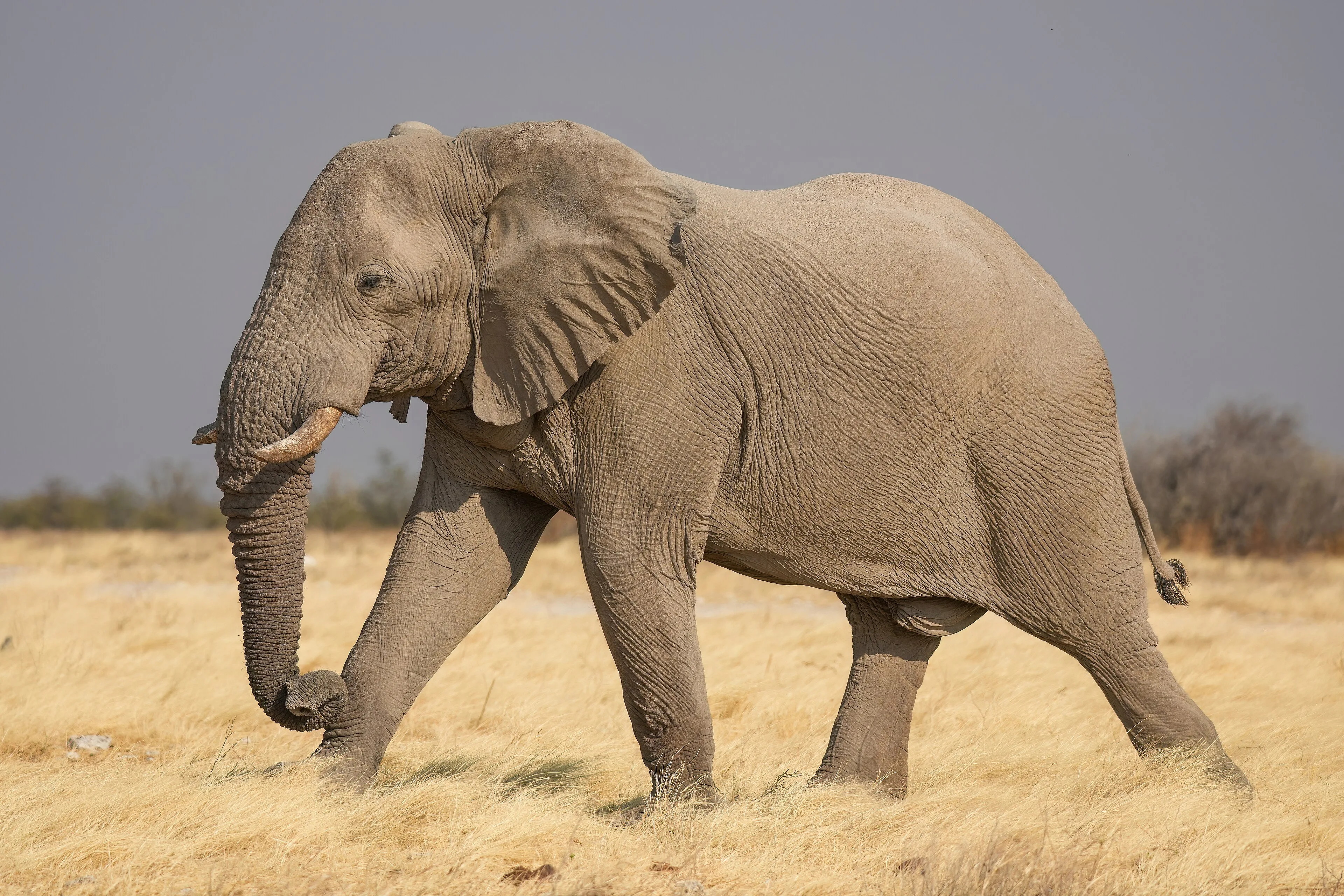
🐘 Elephant: 6,000 kg. 70-year memory. Family power.
🦏 Rhino: 2,300 kg. Armored charge. They almost never fight.
Battle Blog
The elephant chose memory and family. The rhino chose armor and charge. They share the same grasslands and almost never fight.
That is the real story: not constant combat, but two completely different ways of becoming a giant on the African savanna.
Elephant
Rhino
The Numbers
The raw data explains why the elephant usually wins direct matchups and why the rhino still deserves respect.
| Trait | African Elephant | White Rhino |
|---|---|---|
| Maximum weight | Up to about 6,000 kg | Up to about 2,300 kg |
| Typical adult male weight | 4,000-5,000 kg | 1,800-2,300 kg |
| Shoulder height | Up to about 3.3 m | Up to about 1.8 m |
| Body length | 6-7.5 m | 3.7-4.2 m |
| Top speed | About 25 km/h | Up to about 55 km/h |
| Skin thickness | Thick, folded skin | Very thick armor-like skin |
| Primary weapon | Tusks, trunk, mass, feet | Horn, charge, mass |
| Brain weight | About 5 kg | Much smaller; less studied |
| Social structure | Matriarchal family groups | Mostly solitary |
| Wild lifespan | 60-70 years | 35-45 years |
| Gestation | About 22 months | About 16-18 months |
| Vision | Modest | Poor |
| Smell | Excellent | Excellent |
| Conservation | Savanna elephant endangered; forest elephant critically endangered | Species range from Near Threatened to Critically Endangered |
| Wild population | About 415,000 African elephants | About 22,540 African rhinos at end of 2024 |
Size & Strength
In raw size, there is no contest. But the rhino compensates with armor, speed, and a forward weapon built for penetration.
A large African elephant can be more than twice the mass of a white rhino. In any collision, mass changes the physics before strategy even begins.
The elephant combines tusks, trunk, legs, shoulders, and sheer weight. It can push, sweep, lift, shove, and trample instead of relying on one attack.
The rhino is smaller but built like a compact armored vehicle: low center of gravity, thick skin, heavy head, and a forward weapon.
Speed & Weapons
The elephant is bigger. The rhino is much faster. A short-distance rhino charge is the one part of this matchup the elephant must take seriously.
| Speed measure | Elephant | Rhino |
|---|---|---|
| Top speed | About 25 km/h | Up to about 55 km/h |
| Acceleration | Slow but powerful | Explosive charge |
| 100 m estimate | Roughly 14 seconds at top speed | Roughly 7 seconds at top speed |
| Turning | Limited by size | Better, but still heavy |
| Best terrain | Open ground and woodland | Short open-ground charge |
Elephant system
An elephant can use tusks for side pressure, the trunk for contact and manipulation, and body mass for decisive pushing. It can also choose not to engage.
Rhino system
A rhino's best attack is a short explosive charge. If the horn lands well, it can cause catastrophic injury. If it misses, the rhino has to reset.
Intelligence
This is where the comparison becomes unequal. Elephant intelligence belongs in the same serious conversation as gorilla and whale cognition; rhino intelligence is more solitary and territorial.
| Dimension | Elephant | Rhino |
|---|---|---|
| Brain | Largest land animal brain | Capable but much less studied |
| Social cognition | Highly developed matriarchal families | Mostly solitary territorial behavior |
| Memory | Decades-long ecological and social memory | Strong territory and resource memory |
| Tools | Observed tool use | Limited evidence |
| Self-recognition | Mirror self-recognition evidence | No comparable evidence |
| Conflict strategy | Assessment, avoidance, coordinated defense | Threat detection, charge, retreat |
In the Wild
Forget the fantasy bracket. In real savanna encounters, the most common outcome is not violence. It is space, signals, and indifference.
Elephants and rhinos often share space without meaningful conflict because they do not use the savanna in the same way. The absence of fighting is the real ecological answer.
At scarce water sources, elephant groups usually control the social space. A solitary rhino has little reason to challenge a multi-generational elephant family.
Conflict is most plausible when a rhino approaches calves, misreads distance because of poor eyesight, or encounters a bull elephant in musth.
Who Wins?
The elephant wins most direct scenarios. The point is not that the rhino is weak. It is that the elephant is in a different size-and-cognition category.
The elephant has the decisive mass and intelligence advantage. The rhino's charge is dangerous, but the elephant has more ways to absorb, avoid, and punish a miss.
This is the real savanna answer. The rhino withdraws or is displaced because challenging a coordinated family group has no payoff.
A more volatile scenario. Black rhinos are more aggressive and the elephant may be less cautious during musth, but the elephant still holds the size advantage.
The better question is why they almost never need to find out. They do not truly compete for the same role. The savanna has room for family intelligence and solitary armor.
Conservation
The elephant and rhino survived predators, droughts, and climate shifts. Human demand for ivory and horn is the pressure neither strategy evolved to survive.
African elephants
~415K
Broad African elephant estimate used by WWF.
African rhinos
22,540
International Rhino Foundation count at the end of 2024.
Black rhinos
6,788
Slow recovery, still critically endangered.
| Measure | Elephant | Rhino |
|---|---|---|
| IUCN status | Savanna elephant endangered; forest elephant critically endangered | White rhino near threatened; black rhino critically endangered |
| Wild population | About 415,000 African elephants | About 22,540 African rhinos at end of 2024 |
| White rhino | - | 15,752 at end of 2024 |
| Black rhino | - | 6,788 at end of 2024 |
| Main threat | Ivory poaching and habitat loss | Horn poaching and habitat loss |
| Long trend | Major declines in recent decades | White rhino pressured; black rhino slowly recovering |
Go Deeper
The comparison is one doorway into a larger savanna network: species guides, the hybrid generator, and the broader savanna animals hub.
The size of an elephant. The armor of a rhino. The intelligence of an elephant. What would that look like?
Create the Hybrid →The largest land animal. The longest memory. A family society built around experience.
Explore the Elephant →Elephants and rhinos share their home with lions, cheetahs, giraffes, and many more.
Explore the Savanna →Savanna Navigation
Elephant, rhino, the comparison page, and the savanna hub now form the first grassland comparison triangle.
FAQ
In most scenarios, the elephant wins. A large African elephant can weigh up to about 6,000 kg, more than twice the mass of a white rhino. The rhino is faster and has a dangerous horn, but the elephant has size, reach, intelligence, and more tactical options. Against an elephant family group, a single rhino has almost no chance.
The African elephant is the largest land animal, reaching roughly 6,000 kg and about 3.3 m at the shoulder. The white rhino, the largest rhino species, reaches about 2,300 kg and about 1.8 m at the shoulder. The elephant is roughly 2.5 times heavier and much taller.
Yes. Elephants have the largest brain of any land animal, live in complex matriarchal families, use tools, show mourning behavior, and can remember social and ecological information for decades. Rhinos are capable animals with strong territorial and sensory awareness, but they do not show the same level of known social cognition.
Rarely. In normal encounters they ignore each other or the rhino yields, especially near waterholes where elephant groups dominate the social space. Fights are most likely when a rhino approaches calves or when a bull elephant is in musth.
International Rhino Foundation figures put Africa's rhino population at about 22,540 at the end of 2024, including 15,752 white rhinos and 6,788 black rhinos. All rhinos still face poaching pressure and habitat pressure.
Yes. A rhino can charge at up to about 55 km/h, while an elephant's top speed is around 25 km/h. Speed gives the rhino its main edge, but it is a short-distance advantage and does not erase the elephant's mass and strategic advantages.