Scientific name
Ceratotherium simum
White rhino, the largest living rhino species
🦏 Rhinos have existed on a 50-million-year evolutionary timescale.
Horn is keratin. Northern white rhino: 2 left, both female.
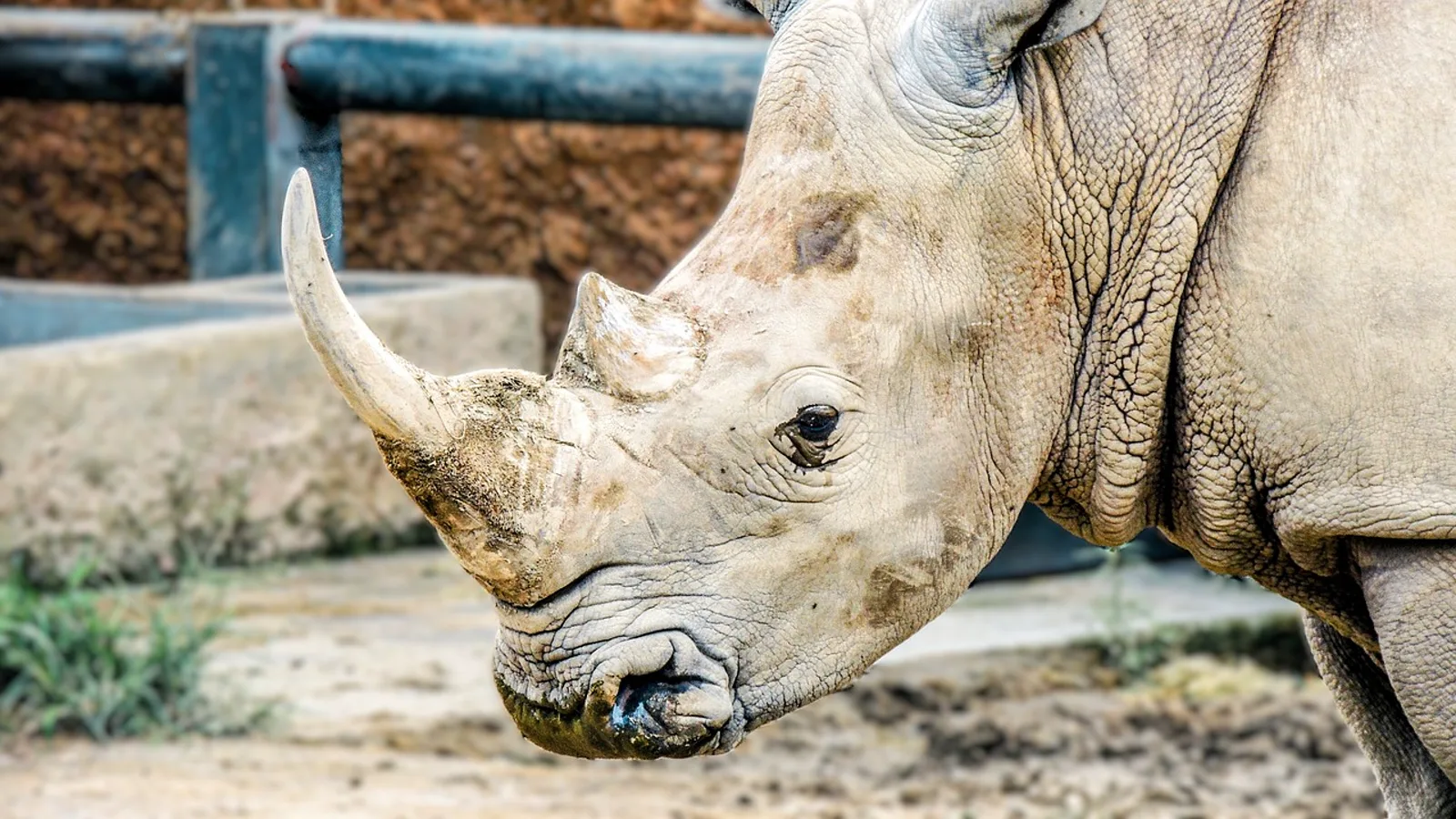
Species Profile
50 Million Years Old. Killed for Something Worth Less Than a Fingernail.
The rhinoceros survived ice ages, climate shifts, and the rise and fall of ancient megafauna. Its horn is keratin, the same protein in your fingernails.
That material has no verified medicinal value. Yet illegal demand helped push the northern white rhino to two living individuals: Najin and Fatu, both female, with survival now depending on frozen genetic material and lab work that has not yet produced a calf.
📅 50M yrs — evolutionary lineage frame
⚖️ 2,300 kg — max white rhino weight
🦄 1.5 m — exceptional horn length
🌍 22,540 — African rhinos at end 2024
Source context: International Rhino Foundation, Save the Rhino, WWF, BioRescue, and WWF species profiles.
Fast Facts
Scientific name
Ceratotherium simum
White rhino, the largest living rhino species
Maximum weight
2,300 kg
Large male white rhinos reach the top of the range
Shoulder height
1.8 m
White rhino baseline
Body length
3.7-4.2 m
Head and body length for large white rhinos
Top speed
55 km/h
Short-distance charge speed
Skin thickness
~5 cm
A collagen-rich hide that still needs mud and shade
Horn material
Keratin
The same structural protein found in fingernails and hair
Longest horn
Up to ~1.5 m
Exceptional white rhino horns can approach this length
Horn regrowth
~7 cm/year
Horn can regrow after dehorning or breakage
Wild lifespan
35-45 years
Varies by species and protection
Gestation
16-18 months
One calf at a time
Social structure
Mostly solitary
White rhinos are the more social exception
Vision
Poor at distance
Smell and hearing carry the sensory load
Living species
5
Two African species and three Asian species
African total
22,540
IRF/SRI 2024-end figure for white plus black rhinos
The Horn Truth
Rhino horn is not bone. It is keratin: the same structural protein that forms human fingernails and hair. The tragedy is that a material with no verified medicinal value can become expensive enough in illegal markets to erase a 50-million-year lineage.
01
Rhino horn is keratin. It is not bone, has no antler-like bony core, and grows from specialized skin cells in dense, layered fibers.
02
There is no scientifically verified medicinal value. The claim that rhino horn cures fever, cancer, or hangovers is demand-side mythology, not biology.
03
The often-cited illegal-market figure reaches about $65,000 per kilogram. That price is a crime-market signal, not a property of the material.
04
Horn can regrow, which is why some reserves dehorn rhinos under anesthesia. It reduces incentive but does not remove all poaching risk.
05
Biotech substitutes may reduce pressure or accidentally legitimize demand. Conservationists still debate whether synthetic horn helps or hurts.
Five Species
Rhinoceros covers five living species, not one animal. The group ranges from the 2,300 kg white rhino to the tiny, hairy Sumatran rhino. The conservation story ranges from recovery to a subspecies represented by two aging females and a laboratory freezer.
Ceratotherium simum
Southern white rhinos are the great recovery story. Northern white rhinos are down to Najin and Fatu, both female, making natural reproduction impossible.
Diceros bicornis
Black rhinos recovered from a 1990s low but remain critically endangered. Their survival depends on anti-poaching, habitat protection, and translocations.
Rhinoceros unicornis
Strict protection in India and Nepal turned a near-collapse into a major conservation recovery, though the population remains concentrated.
Rhinoceros sondaicus
All surviving Javan rhinos are confined to one protected area, so disease, poaching, or a single disaster could reshape the species' entire future.
Dicerorhinus sumatrensis
The Sumatran rhino's deepest problem is isolation: animals are so scattered that finding mates can be harder than surviving predators.
| Species | Population | IUCN frame | Trend |
|---|---|---|---|
| Southern white rhino | 15,752 | Near Threatened | Declining |
| Northern white rhino | 2 | Critically Endangered | Functionally extinct |
| Black rhino | 6,788 | Critically Endangered | Slow recovery |
| Greater one-horned rhino | ~4,075 | Vulnerable | Increasing |
| Javan rhino | ~76 or fewer | Critically Endangered | Extremely fragile |
| Sumatran rhino | 34-47 | Critically Endangered | Declining |
Senses & Behavior
A rhino looks like a tank, but its survival system is not just brute force. It is a smell-first, territory-first animal that moves through the world using scent, sound, mud, memory, and sudden acceleration.
Rhinos do not read the world primarily through sight. At distance, a still object can be unclear, which helps explain sudden, seemingly misdirected charges.
Dung middens and urine marks carry identity, sex, territory, and reproductive signals. A rhino landscape is partly a chemical message board.
Rotating ears help locate sound and compensate for poor long-range vision. Hearing and smell decide most threat responses.
The hide is thick, but sun, heat, and insects still matter. Mud baths cool the body and add a temporary insect barrier.
Females stay with calves for years. White rhinos can form small groups, but most rhino life is territorial, low-social, and scent-driven.
Intelligence
Rhinos are not elephants. They do not have elephant-level social cognition or tool use. But solitary survival still demands memory, individual recognition, and practical learning.
A solitary rhino must remember water, mud wallows, salt licks, shade, and safe routes without a herd sharing route knowledge.
Rhinos recognize other rhinos through scent and can distinguish familiar humans in reserve settings, changing behavior by individual.
Managed rhinos can learn routines, barriers, and reward tasks. They are not elephant-level strategists, but they are not reflex machines.
| Cognitive dimension | Rhino | Elephant |
|---|---|---|
| Brain weight | ~400-500 g | 5 kg |
| Social cognition | Basic, mostly solitary | Complex matriarchal family life |
| Tool use | No strong record | Documented |
| Mirror self-recognition | No strong record | Documented |
| Spatial memory | Strong within territory | Exceptional across landscapes |
| Conflict style | Charge and pressure | Assess, coordinate, and switch tactics |
For the full strategic comparison, see elephant vs rhino.
The Last Two
Their names are Najin and Fatu. They are mother and daughter. They live in Kenya under constant protection. They are the last two northern white rhinos on Earth, both female, and neither can reproduce naturally.
March 19, 2018
Sudan, the last male northern white rhino, was euthanized at age 45 after age-related health decline. Scientists preserved genetic material. BioRescue and partners are now attempting embryo creation, IVF, and surrogate pregnancy using southern white rhinos. No northern white rhino calf has been born through this process yet.
Female, mother of Fatu, one of the last two northern white rhinos.
Female, daughter of Najin, currently central to oocyte collection work.
The last male northern white rhino; died March 19, 2018, aged 45.
Both surviving females cannot reproduce naturally.
Frozen sperm, lab-created embryos, IVF, and embryo transfer into southern white rhino surrogates.
Conservation
22,540
African rhinos at the end of 2024: white plus black rhinos.
2
Northern white rhinos left. Both are female.
34-47
Estimated Sumatran rhinos, one of the most urgent mammal recoveries.
| Species | Recent figure | Main threat | Conservation note |
|---|---|---|---|
| Southern white rhino | 15,752 | Poaching, habitat pressure | Still the largest rhino population |
| Northern white rhino | 2 | No natural reproduction | Depends on assisted reproduction |
| Black rhino | 6,788 | Poaching and habitat loss | Increasing from historic lows |
| Greater one-horned rhino | ~4,075 | Habitat concentration | Conservation success with concentration risk |
| Javan rhino | ~76 or fewer | Tiny single-site population | No safety margin |
| Sumatran rhino | 34-47 | Isolation and low breeding | Captive breeding and habitat protection are urgent |
Southern white rhinos were down to a tiny remnant population in the late 1800s. Black rhinos fell to roughly 2,400 in the 1990s. Both recoveries show that protection works when money, habitat, enforcement, and political will stay aligned. The open question is whether that will can last long enough for the species already at the edge.
Generator Links
White, black, Javan, Sumatran, or greater one-horned. One click, one rhino profile.
Generate Now →6,000 kg vs 2,300 kg. Family vs solitude. Who wins, and why they almost never fight.
See the Comparison →Rhino armor plus elephant intelligence, or rhino speed with another animal's body plan.
Try Hybrid Generator →Savanna Network
FAQ
Recent conservation figures put Africa's rhino total at 22,540, including 15,752 white rhinos and 6,788 black rhinos. Asian species add roughly 4,075 greater one-horned rhinos, about 76 or fewer Javan rhinos, and an estimated 34-47 Sumatran rhinos. The northern white rhino subspecies has only two living individuals, both female.
Rhino horn is made primarily of keratin, the same structural protein found in human fingernails, hair, and horse hooves. It is not bone and has no scientifically verified medicinal value, despite demand in illegal markets.
Large rhinos can charge at roughly 55 km/h over short distances. That makes a rhino much faster than an elephant in a sprint, though poor eyesight and limited turning agility make the charge less precise than it looks.
The rhinoceros family line is commonly described on a tens-of-millions-of-years scale, with the page using 50 million years as the evolutionary-lineage frame. The five living species are the remaining fragments of a once far more diverse rhino radiation.
Sudan, the last male northern white rhino, died at Ol Pejeta Conservancy in Kenya on March 19, 2018, aged 45. The only surviving northern white rhinos are Najin and Fatu, both female, and scientists are attempting IVF and embryo transfer work using preserved genetic material.
Rhino horn is expensive because illegal demand, rarity, trafficking networks, and prohibition create a high-risk black market. The price says more about criminal economics and false beliefs than about the material itself, which is keratin.
Both are gray. White rhinos are larger, have wide square lips for grazing, and are generally more social. Black rhinos are smaller, have hooked lips for browsing shrubs and trees, and tend to be more reactive and solitary.
No. Rhinos are odd-toed ungulates, more closely related to horses and tapirs. Elephants belong to Proboscidea. Their similar size and African overlap are convergent ecology, not close kinship.