Scientific name
Loxodonta africana
Asian: Elephas maximus
African savanna elephant and Asian elephant
🐘 The largest land animal on Earth.
A brain that remembers for 70 years. African savanna elephants declined 30% in just one decade.
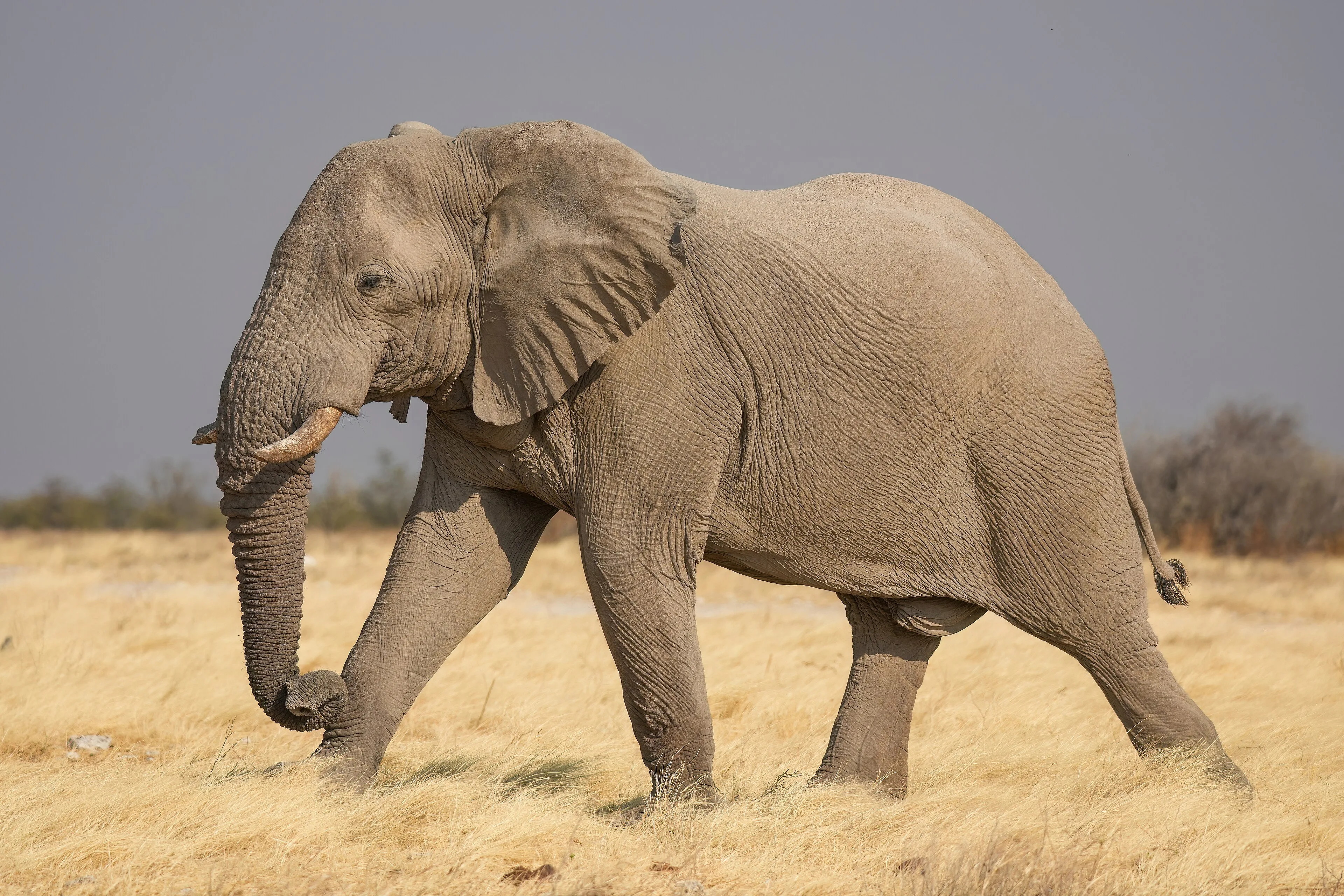
Species Profile
Loxodonta africana / Elephas maximus
The lion chose the pride. The tiger chose solitude. The elephant chose memory.
It carries decades of knowledge in the heaviest brain of any land animal. It remembers family, mourns its dead, recognizes itself in a mirror, and follows the oldest female because experience is survival.
⚖️ 6,350 kg — max recorded African bull weight
🧠 5 kg — brain weight
📅 70 years — maximum wild lifespan
🌍 ~415,000 — African elephants remaining
Source context: IUCN, WWF, IFAW, Smithsonian, and Animal Diversity Web.
Fast Facts
Scientific name
Loxodonta africana
Asian: Elephas maximus
African savanna elephant and Asian elephant
Male weight
4,000-6,350 kg
Asian: 3,500-5,000 kg
African bulls are the heaviest living land animals
Shoulder height
3.2-4.0 m
Asian: 2.4-3.1 m
Asian elephants are smaller and more compact
Trunk muscles
~40,000
Asian: ~40,000
No bones, extraordinary strength and precision
Brain weight
~5 kg
Asian: ~4.5 kg
The heaviest brain of any land animal
Wild lifespan
60-70 years
Asian: 60-80 years
Longevity is eventually limited by tooth wear
Gestation
22 months
Asian: 18-22 months
The longest pregnancy of any land animal
Daily water
~190 liters
Asian: ~140 liters
Large adults may drink more in hot landscapes
Daily food
~136 kg
Asian: ~150 kg
Mostly grasses, leaves, bark, fruit, and roots
Conservation
Vulnerable
Asian: Endangered
Forest elephants are separately Critically Endangered
Wild population
~415,000
Asian: ~40,000-50,000
Regional trends vary sharply by protection and conflict
Society
Matriarchal herd
Asian: Matriarchal herd
Older females carry route, water, and danger knowledge
Elephants are built for endurance, not speed. For a very different body plan, compare them with the fastest animals and the cheetah.
Intelligence
Intelligence is hard to measure across species, but the mirror test cuts through the noise. Humans pass. Great apes pass. Dolphins pass. Elephants pass. That makes the elephant one of the few non-primate animals with confirmed self-awareness.
01
In the Bronx Zoo mirror-test study, the Asian elephant Happy touched a mark on her own head while looking in a mirror. That behavior places elephants on the short list of animals with confirmed self-awareness.
02
Elephants recognize voices, scents, routes, water holes, and danger zones across many years. In droughts, the oldest female's memory can decide whether calves survive.
03
Elephants linger around elephant bones, touch skulls and tusks with their trunks, and show stronger responses to family remains than to unrelated bones.
04
Elephants use branches to swat flies, bark or debris to cover water holes, and objects to scratch places their trunks cannot comfortably reach.
05
Experiments show elephants can wait for a partner when a task requires two individuals to pull together, suggesting they understand the role of another actor.
06
Field accounts describe elephants assisting trapped or distressed animals and showing strong emotional responses to familiar human caretakers.
| Ability | Elephant | Chimpanzee | Dolphin | Dog |
|---|---|---|---|---|
| Mirror self-recognition | Yes | Yes | Yes | No |
| Tool use | Yes | Yes | Yes | Limited |
| Mourning behavior | Yes | Yes | Limited | Limited |
| Long-term memory | Decades | Years | Years | Years |
| Cooperative problem-solving | Yes | Yes | Yes | Yes |
The Trunk
The elephant's trunk is simultaneously a hand, a nose, a snorkel, a weapon, a trumpet, and a social bonding tool. It can move a log, pick up a single grape, smell water at distance, and send low-frequency signals through the ground.
The trunk is the main breathing passage and can work as a snorkel in water.
A huge olfactory system helps elephants detect water, food, and other elephants over long distances.
African elephants have two trunk-tip fingers; Asian elephants have one.
The trunk can lift heavy objects, strip bark, shove trees, and move logs.
An adult can draw several liters into the trunk at once before spraying it into the mouth.
The trunk helps produce trumpets, rumbles, and low-frequency communication.
Trunk contact is greeting, reassurance, exploration, discipline, and bonding.
A trunk strike can knock predators away and create space around calves.
Elephants produce rumbles below the human hearing range. Those sounds can travel for kilometers, and other elephants can detect vibrations through the feet. What looks like silence to us can be a wide-area social broadcast.
Herd Life
The lion pride is defended by male coalitions. The elephant herd is led by the oldest female. In the savanna animals world, experience can outlast strength.
A family usually includes related females and calves, often 6-12 individuals. The oldest female leads because she remembers water, migration routes, risky humans, and predator behavior.
Older matriarchs improve calf survival in hard years. When a matriarch is killed, the herd loses a living map and a social decision-maker.
Males leave the family in adolescence and live alone or in loose male groups. During musth, testosterone can surge and aggression rises sharply.
| Species | Leader | Leadership logic | Group size |
|---|---|---|---|
| Elephant | Oldest female | Experience and memory | 6-12 core family |
| Lion | Male coalition | Strength and defense | 5-15 pride |
| Wolf | Breeding pair | Family cooperation | 5-10 pack |
| Chimpanzee | Alpha male | Power and alliances | 20-60 community |
Species & Subspecies
For most of history, people spoke as if there were two elephants. Genetic analysis revealed a third: the African forest elephant, distinct enough to stand as its own species in the heart of forest animals habitat.
Loxodonta africana
Savanna elephant populations fell sharply in the 2007-2014 poaching surge. In some regions, ivory killing exceeded the reproductive rate.
Loxodonta cyclotis
Forest elephants open paths, disperse seeds, and shape rainforest structure. Their decline changes the future of Central African forests.
Elephas maximus
Asian elephants live across fragmented forests, farms, roads, and cities. Keeping migration corridors open is central to survival.
Ivory Crisis
144,000
African elephants estimated killed between 2007 and 2014
30%
African savanna elephant decline across roughly one decade
33%
tuskless female share after intense poaching in one Mozambique population
A tusk is an incisor that grows throughout life. To an elephant it is a tool for digging, bark stripping, moving objects, and fighting. To poachers it became a high-value commodity. The result was not only population collapse, but rapid human-driven evolution toward tusklessness in heavily poached populations.
Between 2007 and 2014, the ivory crisis removed tens of thousands of elephants, with severe regional losses.
When tusked individuals are killed first, tuskless females survive and reproduce at higher rates.
The 1989 CITES ivory ban helped, but legal sales and illegal markets have repeatedly changed poaching pressure.
Myth vs Reality
The legend says dying elephants walk to a hidden graveyard. The reality is more interesting: tooth wear, soft vegetation, water, repeated deaths, and an animal that pays unusual attention to elephant bones.
1
Elephant graveyards as secret fixed places are a myth.
2
The myth has a biological basis: elephants have six tooth sets that wear down through life.
3
Old elephants often move toward soft vegetation and water when chewing becomes difficult.
4
Repeated deaths near river beds can create visible bone accumulations.
5
Elephants also show unusual attention to elephant bones, especially skulls and tusks.
Generator Links
African savanna? Asian forest? The largest land animal in one click.
Generate Now →What if an elephant had a giraffe's neck or a rhino's armor? Find out.
Try Hybrid Generator →The elephant shares its world with lions, cheetahs, and giraffes. Explore the full cast.
Explore Savanna →FAQ
African savanna elephants are the heaviest land animals, with males weighing 4,000-6,350 kg. The largest recorded individual weighed approximately 10,400 kg. Asian elephants are smaller, with males weighing 3,500-5,000 kg. Female elephants of both species weigh roughly 50-60% of males.
African elephants can live 60-70 years in the wild. Asian elephants have a slightly longer potential lifespan of up to 80 years. Males typically reach full size at 35-40 years. Lifespan is ultimately limited by tooth wear: elephants have 6 sets of teeth, and when the last set wears out, they can no longer eat normally.
Elephants are among the most cognitively complex non-primate animals. They pass the mirror self-recognition test, demonstrate long-term memory spanning decades, exhibit mourning behavior for deceased family members, use tools, and solve cooperative problems. Their brain weighs approximately 5 kg, the heaviest of any land animal.
An elephant's trunk contains approximately 40,000 muscles but no bones. This makes it simultaneously one of the strongest and most precise appendages in the animal kingdom. It can uproot trees and also pick up a single grape without crushing it. African elephants have two trunk fingers at the tip; Asian elephants have one.
Approximately 415,000 African savanna elephants remain in the wild, while African forest elephants number around 100,000 and Asian elephants have about 40,000-50,000 remaining. Combined, fewer than 600,000 elephants of all species survive, down dramatically from historical populations.
African elephants are larger, have larger ears, and both sexes typically have tusks. Asian elephants are smaller, have smaller rounded ears, and only some males have tusks. African elephants have two trunk fingers; Asian elephants have one. They are classified in different genera: Loxodonta and Elephas.
The saying has biological basis. Elephants demonstrate long-term memory spanning at least 12 years for individual recognition, and matriarchs retain knowledge of migration routes, water sources, and danger zones accumulated over decades. However, never forget is an exaggeration: elephants do forget, but their memory capacity far exceeds most mammals.
Elephant graveyards as fixed locations are a myth, but they have a biological basis. Elephants have 6 sets of teeth; when the last set wears out around age 60-70, they move toward areas with soft vegetation near water. Multiple old elephants dying in the same area can create bone accumulations that inspired the legend.
Decades of ivory poaching have created evolutionary pressure against tusk growth. In Mozambique, the proportion of tuskless female elephants rose from about 18% to 33% after intense civil-war poaching. Elephants with tusks were systematically killed, leaving tuskless individuals to reproduce.