Scientific name
Vulpes vulpes
Red fox, the most widespread fox species
🦊 Lives on every continent except Antarctica.
Thriving in the Arctic, the Sahara, and the streets of London.
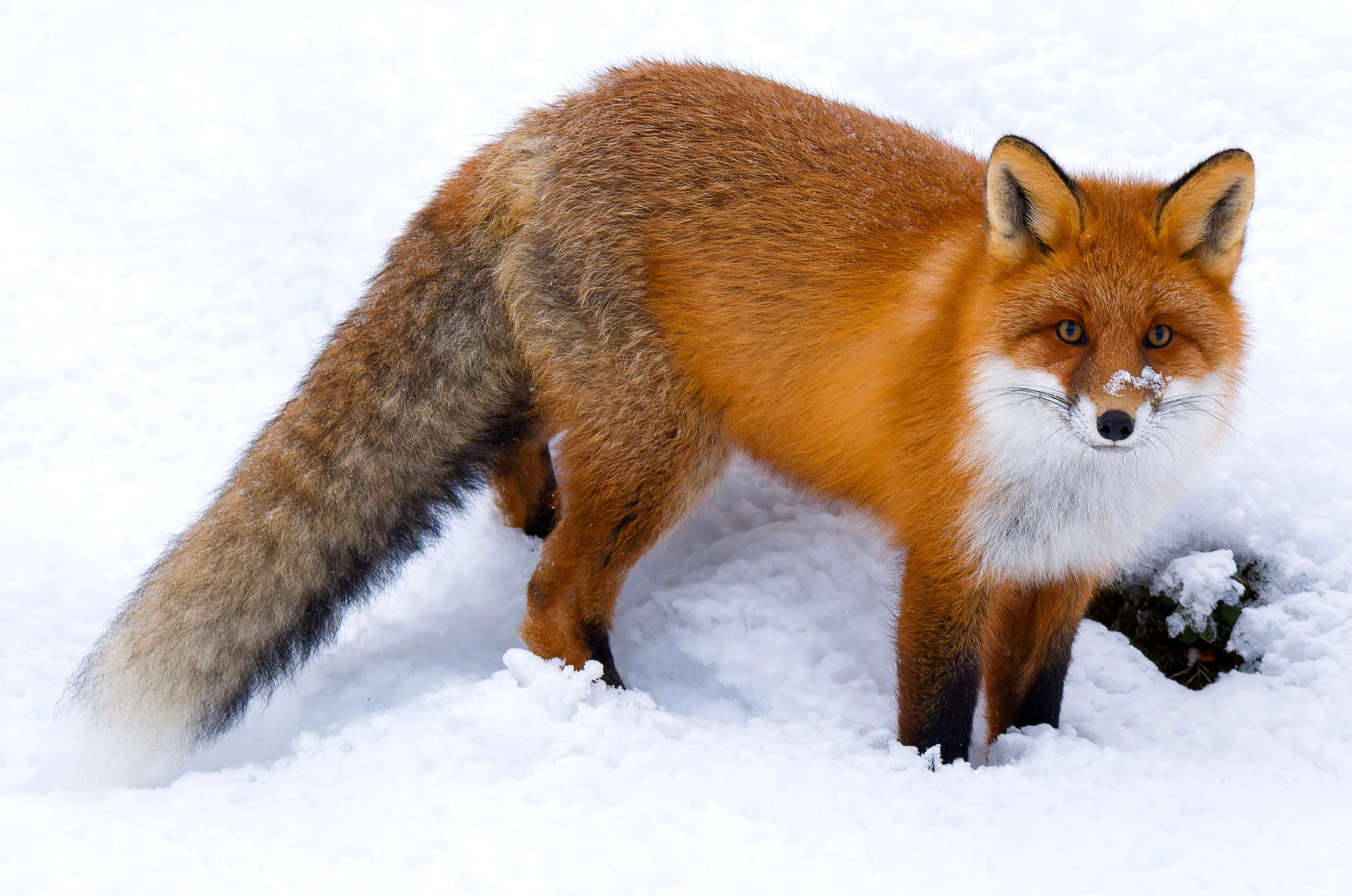
Species Profile
Vulpes vulpes
The wolf bet on the pack. The tiger bet on strength. The cheetah bet on speed. The fox bet on its brain.
It is not the fastest predator, not the strongest, and not the largest. But it turns tundra, desert, farmland, and city streets into habitat.
🌍 Every continent - except Antarctica
🌡️ Arctic to desert - extreme climate range
🏙️ 10,000+ - often cited London urban estimate
🦊 37 species - broad fox group worldwide
Source context: Animal Diversity Web, Britannica, Royal Society Biology Letters, Scientific Reports, and silver fox experiment reviews.
Fast Facts
Scientific name
Vulpes vulpes
Red fox, the most widespread fox species
Weight
3-14 kg
Large regional and sex-based variation
Length
90-150 cm
Including tail; tail may be about 40% of body length
Top speed
50 km/h
Fast enough for short pursuit and escape
Jump height
About 2 m
Vertical leap used in pouncing and escape
Hearing
Tiny prey under cover
Rotating ears locate hidden movement
Wild lifespan
3-5 years
Captive red foxes can live much longer
Diet
Flexible omnivore
Small mammals, fruit, insects, carrion, waste
Social structure
Solitary or small family
Adjusts with food density
Distribution
Every continent except Antarctica
Native plus introduced range
Fox group
About 37 species
Broad common-name group across several genera
Status
Least Concern
Red fox globally, though not all foxes are secure
Adaptability
Most animals are specialists. The cheetah is built for speed on open grassland. The polar bear is built for Arctic ice. Remove a specialist from its world, and the design begins to fail.
The fox is the opposite: a generalist with enough behavioral flexibility to turn almost any landscape into an opportunity.
A fox is not a carnivore that occasionally snacks on fruit. It is a seasonal opportunist: voles and rabbits, berries and insects, carrion, cached food, and in cities, whatever humans leave behind.
Red foxes live across tundra, forest, grassland, mountain edge, farmland, suburb, and city. The secret is not one perfect body, but behavior that keeps changing.
Rotating ears, sharp night vision, scent communication, and evidence for magnetic-field-assisted pouncing give foxes more than one way to find food.
Where food is scarce, foxes can live widely spaced and mostly alone. Where food is dense, they can tolerate smaller territories and family helpers.
Urban foxes learn human routines, quiet streets, feeding patterns, and danger zones. Intelligence is not a myth here; it is a survival tool.
| Species | Habitat specificity | Diet specificity | Urban adaptation |
|---|---|---|---|
| 🦊 Fox | Very low | Very low | Highly successful |
| 🐆 Cheetah | High grassland specialization | High carnivore specialization | No |
| 🐯 Tiger | High forest and wetland specialization | High carnivore specialization | No |
| 🦁 Lion | Medium savanna and woodland specialization | High carnivore specialization | No |
| 🐺 Wolf | Medium, broad but wilderness-dependent | Medium, large prey focused | Limited |
Urban Fox
In the 1930s, red foxes began moving into British cities. No one invited them. They looked at the suburbs, gardens, food waste, and missing large predators, then made the obvious fox decision: stay.
Urban fox
Gardens, bins, compost, rodents, rail corridors, sheds, and quiet night streets turn cities into a patchwork habitat. The fox reads that patchwork better than most wild carnivores.
Rural fox
Rural foxes cover more ground, meet more hunting pressure, and depend more directly on seasonal prey. The same animal plays a different game when food is spread thin.
London is often estimated at around 10,000 urban foxes, with large urban populations across Britain. Exact counts vary because foxes are secretive and city surveys are hard.
City foxes tolerate humans at shorter distances, compress territory size where food is dense, and shift activity toward night to avoid direct contact.
A study comparing urban and rural red fox skulls found measurable cranial differences consistent with living around human food and human structures.
People like the idea of wild nature in cities until nature raids bins, screams at night, or walks across the patio. Urban foxes expose how messy coexistence really is.
Intelligence
Aesop's fox, Japanese kitsune, trickster tales, and European folklore all point at the same observation: people kept watching foxes and independently decided this animal was unusually clever.
Red foxes show directional pouncing patterns when hunting hidden prey. The best-supported explanation is that Earth's magnetic field helps calibrate distance and direction.
Foxes bury surplus food across many sites and relocate stores later. This spreads risk and turns short abundance into long-term insurance.
Their ecological success depends on trying new food, new routes, new den sites, and new human-shaped opportunities without overcommitting.
Urban foxes learn which humans are dangerous, which are harmless, and where predictable food appears. The city becomes a map of individual risk.
Beginning in 1959, Dmitry Belyayev and colleagues selected silver foxes for tameness. Within a small number of generations, behavior shifted strongly toward human friendliness.
Species
Fox is not a precise taxonomic term. It describes dozens of animals across multiple genera, united by a body shape and a lifestyle, but adapted to very different worlds.
Vulpes vulpes
The red fox is the global generalist: native predator in one place, invasive disruptor in another, and city resident wherever humans leave ecological openings.
Vulpes lagopus
The Arctic fox survives cold that would kill most mammals. Its winter coat is a living climate system, and its seasonal color shift turns snow into cover.
Vulpes zerda
For more desert context, compare the fennec with other desert animals. Its ears shed heat and locate prey under sand; its furred feet protect it from hot ground.
Urocyon cinereoargenteus
The gray fox is the canid that went vertical. Curved claws and strong forelimbs let it climb trunks and exploit forest animals habitat in a different way.
Vulpes ferrilata
The Tibetan fox became an internet face, but that blunt skull is not a joke. It is part of a plateau predator built around pikas, altitude, and open country.
Vulpes bengalensis
The Bengal fox shows the smaller, leaner side of fox evolution: a light canid that lives among fields, scrub, insects, rodents, and human land use.
Conservation
The red fox is thriving. The Arctic fox is globally stable. The fennec fox is secure. But fox covers many species, and not all of them share the red fox's good fortune.
Red foxes often benefit from agriculture, suburbs, cities, and the removal of larger predators.
Some foxes remain vulnerable because their ranges are tiny, isolated, or rapidly changing.
As the Arctic warms, red foxes move north and compete with smaller Arctic foxes.
Adaptability is powerful, but it is not evenly distributed across every animal called a fox.
Triangle Link
Wolves and foxes share the dog family, but they answer survival in opposite ways. The wolf chose family-scale power. The fox chose flexibility.
| Trait | Fox | Wolf |
|---|---|---|
| Body plan | Small, light, flexible | Large, endurance-built, cooperative |
| Social strategy | Solo or small family | Family pack |
| Food strategy | Eat almost anything available | Target large prey when possible |
| Territory | 2-50 km2 typical range | 25-1,000+ km2 possible range |
| Human landscapes | Often benefits | Often pressured |
| Evolutionary bet | Flexibility | Scale and cooperation |
The wolf did best before humans fragmented the world. The fox may be doing even better after humans changed it.
🐺 Read the Full Wolf vs Fox Breakdown →Generator Links
Red fox? Arctic fox? Fennec? Or something you have never seen before?
Generate Now →What if a fox had a wolf's size, or an Arctic fox's cold tolerance?
Try Hybrid Generator →Same family. Opposite strategies. Solo intelligence vs pack power.
See the Full Comparison →S-Series Species
FAQ
Foxes are highly flexible omnivores. Their diet shifts with season and habitat: small mammals, birds, insects, fruit, carrion, cached food, and in cities, human food waste and pet food. This flexibility is one reason red foxes thrive across so many environments.
Foxes show strong problem-solving, memory, sensory integration, and social learning. Red foxes can cache food and relocate it later, learn human routines in cities, and may use Earth's magnetic field to improve hunting jumps toward hidden prey.
Urban fox numbers are difficult to measure, but London is commonly estimated at around 10,000 red foxes, and large urban populations occur across Britain and many other cities. Urban foxes succeed because cities offer dense food, shelter, and few large predators.
The fennec fox, Vulpes zerda, is the smallest fox and the smallest canid, weighing roughly 0.7-1.6 kg. Its oversized ears help shed heat and locate prey under desert sand, while furred paw pads protect against hot ground.
Most foxes cannot climb trees well. The gray fox, Urocyon cinereoargenteus, is the famous exception: it can climb vertical trunks using curved claws and strong forelimbs, using trees for escape, rest, and access to food.
Arctic foxes are among the most cold-adapted mammals. Their dense fur, compact body, furred feet, and seasonal camouflage let them survive extreme Arctic cold that would be lethal for most fox species.
Yes. Foxes and domestic dogs are both canids, but they are not close enough to interbreed. Red foxes are in the genus Vulpes, while domestic dogs are Canis lupus familiaris. The silver fox experiment showed how quickly selection on tameness can shift canid behavior.
Wolves are much larger, pack-living hunters built for endurance and large prey. Foxes are smaller, mostly solitary opportunists that eat a wider range of foods and adapt more easily to cities. Wolves bet on cooperation; foxes bet on flexibility.