An 11 kg heart
To move blood up a long neck to the brain, the giraffe runs one of the highest blood-pressure systems in the mammal world. Height is powered by cardiovascular force.
🦒 The giraffe's heart weighs about 11 kg. Its tongue is 45 cm. It sleeps very little.
Height is not free.
Species Profile
The Tallest Animal on Earth and the Price It Paid
Height is not free. The giraffe paid for it with its heart, its thirst, and its sleep.
Four species, a high-pressure heart, a purple tongue, dangerous drinking, and the quiet conservation story behind Africa's tallest animal.
5.5 m
Max height
11 kg
Heart
30 min
Sleep floor
45 cm
Tongue
2x
Blood pressure
~140k
Wild pop.
Core idea
The giraffe's height is not a simple gift. It is a trade written into the heart, blood vessels, drinking posture, sleep, and predator risk of the tallest animal on Earth.
To move blood up a long neck to the brain, the giraffe runs one of the highest blood-pressure systems in the mammal world. Height is powered by cardiovascular force.
To drink, a giraffe must spread its front legs or bend down, lowering the head several meters. This is one of its most vulnerable moments around predators.
Wild giraffes sleep in short bursts and can get by on roughly 30 minutes to two hours a day. Lying down is costly when lions are nearby.
Specialized vessels, valves, and tight lower-leg skin help prevent blood from pooling below or rushing dangerously toward the brain.
The giraffe paid for its height with its heart, its thirst, and its sleep. The view was not free.
The neck
High browsing matters, but the long neck is also a weapon and a watchtower. Male giraffes fight by swinging their necks and heads in a behavior called necking.
| Feature | Figure / behavior | Why it matters |
|---|---|---|
| Length | Up to about 2.4 m | The neck alone can be taller than many humans |
| Vertebrae | 7 | Same count as humans; each vertebra is greatly elongated |
| Combat use | Necking | Males swing necks and heads to fight for dominance |
| Feeding use | High browsing | Access to leaves beyond most other browsers |
| Watchtower use | Predator detection | Other animals respond to giraffe vigilance |
4 species
Modern conservation work commonly recognizes four giraffe species, not one. GCF's 2025 estimates total roughly 140,701 wild giraffes; 68,837 refers to Southern giraffes, not the global total.
Giraffa camelopardalis
The most threatened giraffe species; includes very small remnant populations.
Giraffa tippelskirchi
A large East African species with the most ragged, leaf-like spot pattern.
Giraffa reticulata
The classic geometric giraffe pattern.
Giraffa giraffa
The most numerous species in GCF's 2025 estimates.
| Species | Scientific name | Range | Population | Status | Spot pattern |
|---|---|---|---|---|---|
| Northern Giraffe | Giraffa camelopardalis | Central, West, and East Africa | ~7,037 | Critically Endangered | Irregular pale-edged patches |
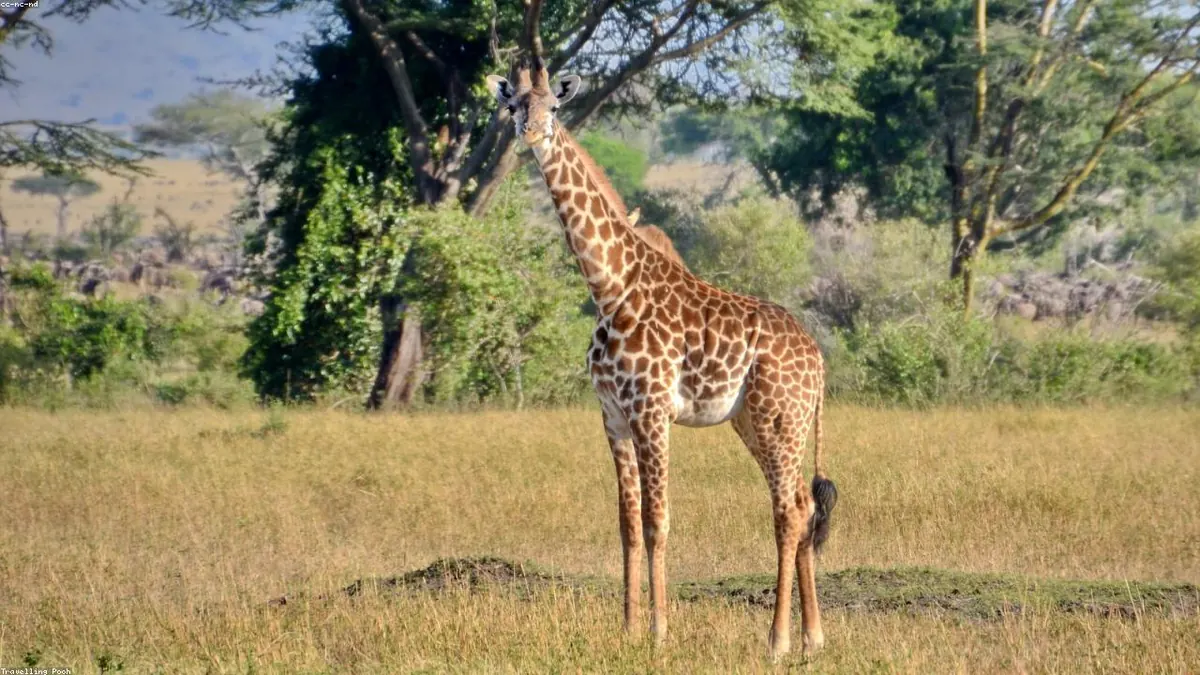
| Masai Giraffe | Giraffa tippelskirchi | Kenya and Tanzania | ~43,926 | Endangered / under reassessment | Jagged vine-leaf patches |
| Reticulated Giraffe | Giraffa reticulata | Northern Kenya, Ethiopia, Somalia | ~20,901 | Endangered / vulnerable concern | Large polygons with bright white lines |
| Southern Giraffe | Giraffa giraffa | Southern Africa | ~68,837 | Least Concern / regional concern | Rounded, more uniform patches |
Diet
The giraffe is a high browser. It lives above much of the savanna's competition, using a long prehensile tongue to strip leaves from thorny trees.
| Fact | Figure | Context |
|---|---|---|
| Primary food | Acacia and other browse | Leaves, shoots, flowers, seedpods |
| Daily intake | Up to ~34 kg | Large adults can eat about 75 lb of vegetation daily |
| Feeding time | Most of the day | Browsing dominates waking hours |
| Tongue length | About 45 cm | Prehensile and dark purple-blue |
| Water | Mostly from leaves | Can go days without drinking when browse is moist |
| Digestion | Ruminant | Four-chambered stomach and cud chewing |
The 45 cm purple-blue tongue is not decorative. Dark pigmentation helps protect a tongue exposed to hours of African sun.
Habitat
Giraffes live in fragmented landscapes across sub-Saharan Africa, especially savanna, woodland, and bushveld where browse trees shape the map.
| Category | Answer | Context |
|---|---|---|
| Range | Sub-Saharan Africa | Now fragmented compared with historical range |
| Habitats | Savanna, woodland, bushveld | Open landscapes with browse trees |
| Preferred trees | Acacia, Combretum, Terminalia | Food quality shapes movement |
| Range pressure | Habitat loss and fragmentation | Farms, fences, roads, conflict, and settlement |
| Savanna role | High browser | Feeds above the reach of most antelope and many elephants |
Baby giraffe
A giraffe calf starts life with a fall. Within about 30 minutes, it must stand; within hours, it must move with the herd.
| Stage | Figure | Why it matters |
|---|---|---|
| Gestation | ~15 months | One of the longest among land mammals |
| Birth posture | Standing birth | Calf drops roughly 2 m to the ground |
| Birth height | ~1.8 m | Already taller than many adult humans |
| Birth weight | ~100 kg | Huge newborn, still vulnerable |
| Time to stand | ~30 minutes | Must stand quickly in predator country |
| Time to run | Within hours | Mobility is survival |
| Nursing | 9-12 months | Calves remain close to mothers |
| First-year mortality | High | Predation is a major risk |
Sound
Giraffes were once treated as almost silent. They were simply quieter, lower, and easier to miss than people expected.
Research has recorded low-frequency humming in giraffes at night, suggesting communication people once missed.
Calves and mothers use quieter vocalizations and contact signals.
Alarm and agitation sounds exist even if giraffes are usually quiet.
Like elephant communication, giraffe sound may include signals that are easy for humans to overlook.
Conservation
Giraffes declined sharply over recent decades while receiving far less attention than elephants or rhinos. New survey work improves the count, but not every population is secure.
Agriculture, settlement, roads, and fencing fragment giraffe range.
Giraffes are killed for meat, hide, tails, bones, and local trade.
Several northern populations live in unstable regions where conservation access is difficult.
Changing rainfall alters browse availability and drought risk.
Giraffe skin disease and other pressures remain under study.
Comparison
The giraffe is the tallest land animal. The elephant is the heaviest. They share landscapes but solve the savanna in completely different ways.
| Feature | Giraffe | African Elephant |
|---|---|---|
| Height | Up to 5.5 m | Up to about 4 m at shoulder |
| Weight | Up to ~1,750 kg | Up to ~6,000 kg |
| Brain size | ~680 g | ~5,000 g |
| Sleep | 30 min-2 hrs wild | Often 2-4 hrs wild |
| Lifespan | 20-25 yrs | 60-70 yrs |
| Social structure | Loose fission-fusion groups | Tight matriarchal families |
| Predator defense | Kick can kill lions | Adults rarely attacked |
| Conservation | Species-specific concern | Vulnerable / endangered by species |
Fast facts
| Fact | Answer | Context |
|---|---|---|
| Tallest animal | Up to 5.5 m | Adult males are tallest |
| Neck length | Up to 2.4 m | Still only seven neck vertebrae |
| Tongue | About 45 cm | Dark and prehensile |
| Heart | About 11 kg | Drives high blood pressure |
| Sleep | 30 min-2 hrs wild | Short bursts, often standing |
| Species | 4 | Northern, Masai, Reticulated, Southern |
| 2025 GCF total | ~140,701 | Sum of four species estimates |
| Main threats | Habitat loss, poaching, conflict | Varies strongly by region |
Explore
This page closes the savanna arc: power, intelligence, survival, and now the price of height.
lion facts
Power line
elephant intelligence
Wisdom line
rhino facts
Survival line
cheetah facts
Speed line
most dangerous animals
Risk context
FAQ
Adult male giraffes can reach about 5.5 meters (18 feet), making giraffes the tallest land animals on Earth. Females are usually shorter, often around 4.5 meters. A giraffe's legs alone can be about 1.8 meters tall.
A giraffe's tongue is about 45 cm (18 inches) long. It is prehensile, meaning it can grip branches, and its dark purple-blue color helps protect it from intense sunlight during long feeding hours.
Wild giraffes sleep very little, often around 30 minutes to two hours per day in short bursts. They can rest while standing and rarely lie down for long because getting up takes time when predators are nearby.
Giraffe conservation status depends on the species and region. GCF's 2025 estimates total about 140,701 wild giraffes across four species, but northern giraffes remain especially threatened at about 7,037 individuals. Threats include habitat loss, poaching, conflict, and climate stress.
Current genetic and conservation work recognizes four giraffe species: northern giraffe, Masai giraffe, reticulated giraffe, and southern giraffe. This four-species view replaced the older single-species framing in much modern conservation work.
The giraffe's long neck helps it browse high leaves, but feeding is not the whole story. Male giraffes also use their necks in combat called necking, swinging the head and neck to compete for dominance and mating opportunities.
Sources and data note
Giraffe taxonomy and population figures are actively revised. This page follows GCF's four-species framing and uses 2025 estimates cautiously.