Representative species
Great white shark
Carcharodon carcharias
🦈 Sharks kill roughly 10 humans per year.
Humans kill tens of millions of sharks. They survived 5 mass extinctions.
Species Profile
450 Million Years of Perfect Design
You are afraid of sharks. That is understandable. The numbers tell a different story.
Sharks existed before trees, before dinosaurs, and before the oceans looked like they do now. They survived five mass extinctions. Then humans arrived.
📅 450M years - older than trees
🦷 ~20,000 - lifetime tooth replacements
🌊 500+ - shark species worldwide
📉 ~70% - oceanic shark and ray decline since 1970
Source context: Smithsonian Ocean, NOAA Fisheries, Nature, Florida Museum, and Science.
Fast Facts
Representative species
Great white shark
Carcharodon carcharias
Length
4-6 m
Females are usually larger than males
Weight
680-1,100 kg
Large adults vary by sex and region
Top speed
About 56 km/h
Short bursts; cruising is far slower
Bite force
About 1.8 tonnes
Estimated for large great whites
Lifetime teeth
~20,000
Rows are continually replaced
Electroreception
0.005 microvolts/cm
Among the most sensitive animal electrical systems
Smell
Trace chemical detection
Often exaggerated; currents determine range
Lifespan
70+ years
Greenland sharks may live 272-512 years
Species
500+
Sharks range from lanternsharks to whale sharks
History
450 million years
Older than trees and dinosaurs
Status
Vulnerable
Great white; many shark species are threatened
Ancient History
Trees appeared around 385 million years ago. Dinosaurs appeared around 230 million years ago. Humans are a rounding error by comparison.
Sharks appeared around 450 million years ago, when the continents and oceans were unrecognizable. Evolution does not preserve designs that fail this many tests.
Sharks can survive lean periods by slowing energy use and moving efficiently through water. Some species travel enormous distances between feeding opportunities.
A shark skeleton is cartilage rather than bone: lighter, flexible, and energy efficient. It also fossilizes poorly, which is why fossil shark teeth matter so much.
Sharks do not run out of functional teeth. New rows move forward throughout life, so tooth wear does not end hunting ability the way it can for land predators.
The shark body plan survived because it is not just fast. It is surrounded by information: smell, hearing, lateral line, vision, taste, touch, and electroreception.
Six Senses
Humans have five senses. Sharks have six. The sixth is electroreception: the ability to detect electrical fields generated by living bodies.
Sharks can detect trace chemicals in water, but the myth of blood sensed from miles away ignores current direction and dilution. Smell is powerful, not magical.
Low-frequency sound travels far underwater. Sharks can detect struggling movement patterns before sight or smell becomes useful.
Pressure-sensitive canals along the body read water movement, vibration, and nearby motion even when visibility is poor.
Many sharks have low-light adaptations. Great whites protect the eyes during close contact, which helps explain the famous rolled-eye look.
A shark's mouth is also an investigative tool. Many bites are exploratory, and the shark leaves when the object does not match normal prey.
Ampullae of Lorenzini detect tiny electrical fields from living animals. This is the sixth sense that lets sharks find hidden prey at close range.
| Sense | Shark | Human | Advantage |
|---|---|---|---|
| Smell | Trace chemical detection | Much weaker | Strong |
| Low-frequency hearing | Very sensitive underwater | 20 Hz lower bound | Better in water |
| Dark vision | Low-light adapted | Baseline | Higher sensitivity |
| Electroreception | Ampullae of Lorenzini | None | Unique |
| Lateral line | Water pressure and vibration | None | Unique |
| Tooth renewal | Continuous replacement | None | Unique |
Attacks - The Truth
Every year, shark incidents are reported like horror stories. Every year, the numbers say the same thing: sharks are not hunting humanity.
| Annual figure | Context |
|---|---|
| ~10 people | annual fatal shark bites worldwide, often lower in recent years |
| ~1,000 people | annual crocodile deaths often cited in public-risk comparisons |
| Hundreds of thousands | annual mosquito-linked disease deaths |
| ~100 million sharks | rough estimate of annual sharks killed by humans, range varies by study |
Sharks do not have hands. A bite can be an investigative contact with an unfamiliar object, followed by leaving rather than feeding.
From below, a surfer's outline can resemble seal-shaped prey, especially in poor visibility and high-surf conditions.
Bull sharks and other nearshore species overlap heavily with humans. More contact points create more incidents without making humans normal prey.
The fear story is emotionally powerful. The ecological story is more important: humans are the dangerous animal in this relationship.
Species
Shark describes more than 500 species, from tiny lanternsharks to the 12-meter whale shark. The lineage is shared; the lifestyles are wildly different.
Carcharodon carcharias
The great white is the shark in popular imagination, but its real story is low reproduction, wide migrations, and vulnerability to human pressure.
Rhincodon typus
The largest shark is not a hunter of humans. It is a giant filter feeder, closer to a living cathedral moving through plankton than a monster.
Sphyrna spp.
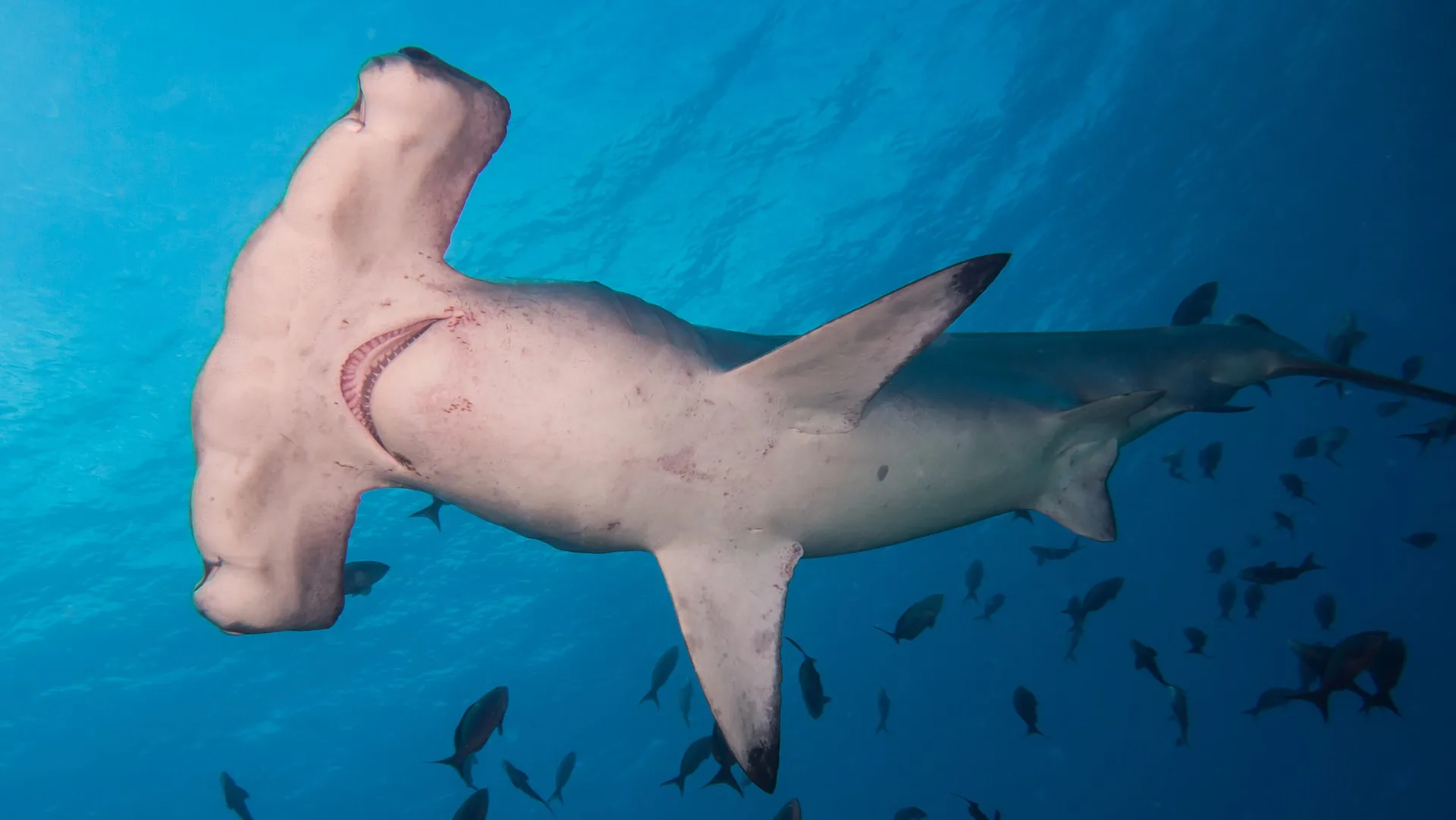
The hammer is a sensory machine: wider electrical search area, expanded visual field, and fine control over prey hidden below.
Carcharhinus leucas
The bull shark can regulate salt balance and move far into rivers, making it one of the most geographically surprising large predators.
Galeocerdo cuvier
Tiger sharks eat almost anything: turtles, birds, fish, carrion, and human debris. That flexibility makes them important ocean cleanup predators.
Somniosus microcephalus
The Greenland shark turns time into habitat. Some individuals may have been alive before the United States existed, moving slowly through cold deep water.
Conservation
Sharks survived asteroid impacts, ice ages, volcanic winters, and oxygen crises. Industrial fishing did in decades what mass extinctions failed to do.
~100M
sharks killed annually by humans, broad estimate
~70%
oceanic shark and ray decline since 1970
500+
known shark species worldwide
272+
minimum estimated years for the oldest Greenland sharks
Tens of millions of sharks are killed annually for fins. Finning removes the most valuable part and often wastes the rest of the animal.
Longlines, nets, and large-scale fisheries catch sharks even when they are not the target. Industrial fishing pressure is the central driver of decline.
Many sharks mature late, gestate slowly, and produce few young. A population can collapse quickly and recover only over decades.
Remove large predators and mid-level species can surge, prey communities shift, and reefs and seagrass systems lose balance.
Generator Links
Great white? Hammerhead? Whale shark? Greenland shark? One click to find out.
Generate Now →What if a shark had a whale's intelligence, or a hammerhead's 360-degree sensory field?
Try Hybrid Generator →The shark shares its world with whales, octopuses, and creatures stranger than imagination.
Explore the Ocean →Ocean Species
FAQ
Sharks kill roughly 10 people per year worldwide, often fewer in recent annual reports. Humans kill tens of millions of sharks each year through fishing, finning, and bycatch. Most shark bites are exploratory incidents, not predation on humans.
Sharks have existed for about 450 million years, making them older than trees, dinosaurs, and flowering plants. They survived multiple mass extinctions because their body plan and sensory systems work exceptionally well.
Electroreception is the ability to detect electrical fields generated by living animals. Sharks use gel-filled pores called ampullae of Lorenzini to sense tiny electrical signals from prey, especially at close range or when prey is hidden.
Many sharks produce around 20,000 teeth over a lifetime. Their teeth are replaced continuously in rows, so they do not lose feeding ability because a permanent tooth wears down or breaks.
The whale shark, Rhincodon typus, is the largest shark and the largest living fish, reaching up to about 12 meters. Despite its size, it filter-feeds on plankton and small fish and is harmless to humans.
The Greenland shark is the longest-lived known vertebrate candidate. Radiocarbon dating suggests some individuals may live at least 272 years, with estimated ranges extending as high as 512 years.
Sharks are threatened mainly by overfishing, fin trade, bycatch, and slow reproduction. Oceanic sharks and rays have declined by about 70 percent since 1970, and many species cannot recover quickly after heavy fishing pressure.
Most sharks cannot survive long-term in freshwater. Bull sharks are the famous exception because they can regulate internal salt balance and travel far into rivers such as the Mississippi, Amazon, and Zambezi.